Every trade has its own language, and the chimney trade has one of the oldest. Some of these words go back to medieval stonemasons, some come from the fire codes written after entire city blocks burned, and some were invented last decade for gas inserts and stainless liners. When a sweep tells you your crown is spalling, your flue tiles are vitrified, or your smoke chamber needs parging, you deserve to know exactly what that means before you say yes to anything.
So we built this: the largest plain-English chimney and firebox dictionary we know of, more than 150 terms, every one explained the way we would explain it standing in your living room. No jargon defined with more jargon. Where a term matters differently in Colorado, thin air, freeze-thaw, wildfire rules, we say so, because a chimney at 6,000 feet does not behave like a chimney at sea level.
Use the table of contents above to jump to any letter, or read the quick-reference tables first: chimney anatomy, creosote stages, inspection levels, damper types, liner materials and venting systems. If a term you hit in a quote or inspection report is not here, ask us and we will add it.
The chimney at a glance
Before the A to Z, here is the whole system in one table, from the fire up to the sky. Every part listed here has a full entry below.
| Part | What it does | How it usually fails |
|---|---|---|
| Firebox | Contains the fire itself | Cracked firebrick, failed mortar joints |
| Damper | Opens and closes the flue | Rusts stuck, warps, seals poorly |
| Smoke shelf | Deflects downdrafts and catches debris | Fills with soot and fallen mortar |
| Smoke chamber | Funnels smoke into the flue | Rough corbeled walls grab creosote |
| Flue liner | Carries exhaust safely through the house | Cracked tiles, open joints, gaps |
| Chimney wall | Structure around the liner | Spalling brick, eroded mortar |
| Crown | Sheds water off the top of the masonry | Cracks, wrong mortar, no overhang |
| Cap | Keeps rain, animals and sparks out | Missing, rusted, undersized mesh |
| Flashing | Seals the roof-to-chimney joint | Lifted metal, dried sealant, leaks |
| Hearth | Fireproof floor in front of the fire | Cracks, insufficient extension |
A
Action Day
A Colorado air-quality alert. On high pollution Action Days from November through March, indoor burning below 7,000 feet in the Denver metro is restricted to approved devices. Fireplaces that are not EPA certified must go cold. See our guide to Colorado chimney laws.
Air-insulated liner
A metal chimney liner that relies on an air gap instead of a blanket wrap for insulation. Cheaper, but at Colorado elevations we usually recommend wrapped liners because they keep flue gases warmer and drafting stronger.
Anchor plate
The steel plate that fastens the bottom of a stainless liner to the firebox or appliance breech, keeping the liner centered and the connection sealed.
Appliance connector
The pipe that runs from a stove or furnace to the chimney. Connectors have their own clearance and slope rules, and many chimney fires start at a bad connector, not in the chimney itself.
Ash dump
A small metal door in the firebox floor that lets you sweep ashes down into a pit below instead of carrying them through the house.
Ash pit
The hollow chamber under the firebox that collects ashes from the ash dump, emptied through a cleanout door in the basement or outside wall. Many Denver homes have decades of ash sitting in one.
B
Backdraft
When air flows down the chimney and into the house instead of up and out, pushing smoke, soot or carbon monoxide into the room. Causes range from a cold flue to a too-tight house running exhaust fans.
Backer rod
A foam rope pressed into wide cracks before sealant goes in, so the sealant cures in the right shape and depth. Used in crown and flashing repairs.
Baffle
A plate inside a wood stove that forces smoke to take a longer path before leaving, burning more of it and sending more heat into the room. A warped or missing baffle wrecks stove efficiency.
Bird guard
Mesh fitted to a cap or pot that keeps birds out of the flue. In Colorado it also keeps out squirrels and raccoons, which is why we treat it as standard equipment, not an upgrade. Related service: humane animal removal.
Blower
The fan kit that pushes room air through channels around a firebox or insert and back out as heated air. A blower can double the useful heat a fireplace delivers to the room instead of the flue.
Breast
The section of chimney masonry that projects into a room, usually above and around the firebox. What most people call the chimney wall inside the house.
Breech
The opening where an appliance's exhaust enters the chimney. A boiler breech, for example, is where the boiler pipe meets the flue.
BTU (British Thermal Unit)
The standard measure of heat output. One BTU raises one pound of water one degree Fahrenheit. Fireplaces and inserts are rated in BTU per hour; a typical gas insert runs 20,000 to 40,000.
Buck stove
A generic nickname for older freestanding wood stoves inserted into fireplace openings, after a popular 1970s brand. Many were slammered in without liners and are serious hazards today.
C
Cap (chimney cap)
The metal hood on top of the flue that keeps rain, snow, animals and debris out while letting smoke through, usually with spark-arrestor mesh built in. The single cheapest piece of protection a chimney can have. See cap repair and installation.
Carbon monoxide (CO)
The colorless, odorless gas produced by incomplete combustion. A blocked or leaking flue can push it into living space, which is why every home with a fuel-burning appliance needs CO alarms and a sound chimney.
Cast-in-place liner
A liner formed by pumping special cement around an inflatable form inside the old flue, creating a smooth new passage that also strengthens the masonry. One of several relining methods.
Catalytic combustor
A honeycomb element in some wood stoves that ignites smoke at lower temperatures, squeezing more heat from the wood and cutting emissions. Combustors wear out and need replacement every few seasons.
Chase
The framed and sided box that encloses a factory-built chimney on homes without masonry, common on newer Colorado builds. What looks like a brick chimney is often a wood-framed chase with siding.
Chase cover
The metal lid sealing the top of a chase. Cheap galvanized covers rust and pond water; stainless covers with a cross-break shed water for decades.
Chimney fire
Creosote inside the flue igniting. Some roar like a jet engine; many burn quietly and are only discovered at the next inspection by the damage they left: cracked tiles, warped metal, puffed creosote. One chimney fire is the reason relining exists.
Chimney pot
The decorative clay or metal tube extending a flue above the crown, a signature of older architecture. Pots add draft height and style, but unlined or cracked pots need the same attention as the flue below them.
Cleanout door
The small metal door at the base of a chimney or ash pit where soot and ash are removed. Should seal tightly; a rusted-open cleanout leaks cold air into the flue and kills draft.
Clearance to combustibles
The required air space between hot surfaces (flue, connector, firebox) and anything that can burn (framing, insulation, mantels). Most hidden fire hazards we find are clearance violations buried in walls.
Combustion air
The air a fire consumes to burn. Every pound of wood needs many times its weight in air, and all of it comes from somewhere: the room, a dedicated outside intake, or leaks in the building. Starve the fire of combustion air and it smolders, smokes and makes creosote.
Corbeling
Stepping courses of brick outward or inward, each course overhanging the last. Smoke chambers were traditionally corbeled, leaving rough ledges that catch creosote unless parged smooth.
Cord
The legal unit of firewood: a stack 4 feet by 4 feet by 8 feet, 128 cubic feet. A face cord or rick is one third of that. Buying wood by the pickup load instead of the cord is how people get shorted.
Creosote
The tar family of deposits left by wood smoke condensing in the flue: flaky first-stage, crunchy second-stage, and glazed third-stage. It is fuel, and removing it is the entire point of sweeping. See the stages table below.
Cricket
A small peaked saddle built on the high side of a wide chimney to split roof water around it. Required on chimneys wider than 30 inches; missing crickets cause chronic flashing leaks.
Crown
The sloped concrete top of a masonry chimney that sheds water away from the flue and over the brick. Crowns crack from freeze-thaw more than anything else in Colorado, and a cracked crown quietly destroys the chimney under it. See crown repair.
CSIA
The Chimney Safety Institute of America, the body that certifies chimney sweeps and publishes the safety standards most inspectors follow.
| Creosote stage | Looks like | Fire risk | Removal |
|---|---|---|---|
| Stage 1 | Dusty gray-black flakes | Low | Standard brushing |
| Stage 2 | Crunchy black granules and flakes | Moderate | Brushing, more passes |
| Stage 3 (glaze) | Shiny hardened tar, drips and runs | Severe, this is what chimney fires burn | Mechanical scouring or chemical treatment |
D
Damper
The metal gate that opens the flue for a fire and closes it afterward to stop heat loss. Throat dampers sit above the firebox; top-sealing dampers close the flue at the crown with a gasket. See the comparison table under T.
Damper clamp
A clamp required on dampers serving gas logs, locking them permanently open so combustion gases can never be accidentally trapped in the house.
Direct vent
A sealed gas appliance that draws combustion air from outside through one pipe and exhausts through another, never touching room air. The safest and most efficient venting for gas fireplaces.
Downdraft
Air pushed down the flue by wind patterns or pressure differences, often felt as a cold draft or smoke puffing into the room. Cap design, flue height and nearby rooflines all play a part.
Draft
The pressure difference that pulls air through the fire and up the chimney. Hot air rises, the column of warm gas in the flue weighs less than the outside air, and the difference does the work. Weak draft means smoke in the room; too-strong draft eats wood. At Colorado altitude the thinner air produces measurably less draft for the same flue, which is why sizing rules matter more here.
Drip edge
The bent lip on caps and chase covers that throws water clear of the masonry or siding below instead of letting it run down the face.
Dryer vent
Not a chimney, but we clean thousands of them: the duct that carries dryer exhaust outside. Lint buildup causes hundreds of house fires a year, and long or flexible runs clog fastest. See dryer vent cleaning.
E
Efflorescence
The white, powdery mineral bloom on brick. It looks cosmetic, but it is proof that water is moving through the masonry and leaving dissolved salts behind on the way out. Find the water, or lose the wall.
Ember bed
The glowing coal layer a wood fire builds on the firebox floor, and also the decorative glowing media in gas log sets that imitates it.
EPA certified
A wood stove or insert tested to meet federal emission limits. In Colorado only certified units may be sold or installed, and only certified units may burn on winter Action Days below 7,000 feet.
F
Face brick
The finished brick you see, as opposed to the structural or backing brick behind it. Fireplace surrounds use face brick rated for appearance, not necessarily for heat.
Fire clay
The heat-resistant clay used in refractory mortar and flue tiles. Repairs in the fire path must use fireclay-based or refractory products, never ordinary masonry mortar.
Firebox
The chamber that actually holds the fire, built from firebrick laid in refractory mortar in masonry fireplaces, or formed metal with refractory panels in factory-built units. Cracks and washed-out joints here let heat reach the structure, which is why firebox condition decides whether you can burn. See firebox repair.
Firebrick
Dense clay brick fired to survive direct flame, rated far beyond ordinary brick. Standard splits are about one and a quarter inches thick. Ordinary brick in a firebox is a red flag from a past bad repair.
Flashing
The layered metal that waterproofs the joint where chimney meets roof: step flashing woven into the shingles, counter flashing let into the mortar joints over it. Most "chimney leaks" are flashing leaks.
Flaunching
The British and old-trade word for the mortar bed that holds clay pots on a chimney top, sometimes used loosely for the crown itself. You will meet it in older manuals and inspection reports.
Flue
The passage that carries smoke from the fire to the open air. One chimney can contain several flues, one per appliance. The flue is the highway; the liner is the pavement.
Flue sizing (10:1 and 12:1 rules)
A masonry fireplace flue should have a cross-sectional area of roughly one tenth the fireplace opening (one twelfth for round flues). Too small and it smokes; too large and it runs cold and creosotes. At altitude we lean toward the generous side of the ratio because thinner air drives less draft.
Flue tile
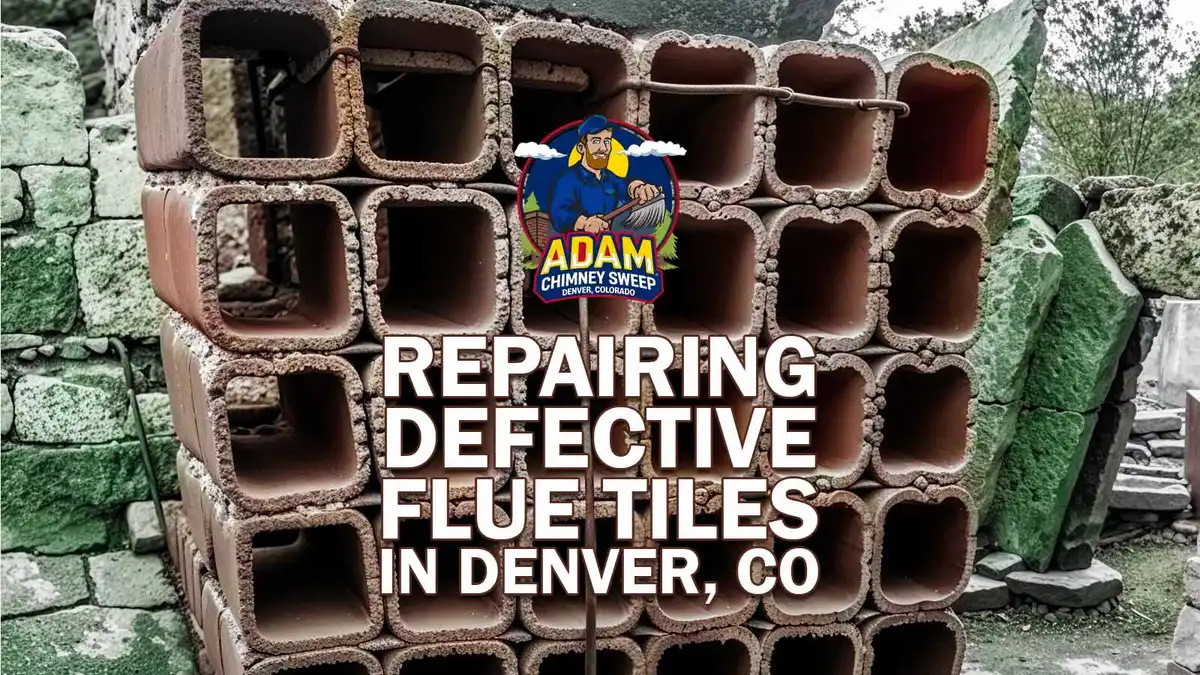
The two-foot clay sections stacked to line traditional masonry flues. Good tiles last generations, but one cracked tile breaks the seal of the whole column, and tiles cannot be repaired individually without relining or resurfacing.
Footing
The concrete base that carries the enormous weight of a masonry chimney. Footing settlement is why chimneys lean away from houses, and no repair above matters until the footing is addressed.
Freeze-thaw
The cycle that kills Colorado masonry: water soaks into brick and mortar by day, freezes and expands by night, and pries the material apart crystal by crystal. The Front Range swings through freezing dozens of times each winter, which is why crowns, caps and waterproofing earn their keep here.
G
Gas insert
A sealed gas fireplace engineered to slide into an existing masonry firebox, with its own liner run up the old flue. The practical upgrade for a fireplace that no longer burns wood safely. See gas inserts.
Gas logs
Decorative ceramic logs over a gas burner set inside an existing firebox. Vented sets burn with the damper clamped open; vent-free sets burn room air and are regulated tightly. Prettier than efficient.
Glazed creosote
Third-stage creosote: smoke tar baked into a hard, shiny lacquer on the flue walls. It cannot be brushed off, it holds the most fuel per pound, and it is the material burning in most serious chimney fires.
Grate
The iron cradle that lifts firewood off the floor so air feeds the fire from beneath. Burned-through grates drop coals against the firebox walls.
H
Header
The structural beam over a fireplace opening carrying the wall above. In masonry fireplaces the lintel does this job; in framed chases a wood header does, and its clearance to the firebox is a common violation.
Hearth
The fireproof floor of and in front of the fireplace. The inner hearth is inside the firebox; the hearth extension projects into the room to catch sparks and embers.
Hearth extension
The noncombustible apron in front of the fireplace opening, with minimum depth and width set by code based on the size of the opening. Rugs and wood floors inside that zone are fuel, not decor.
Heat shield
A protective layer, metal, cement board or masonry, that lets a stove or connector sit closer to a wall than bare clearance rules allow. Shields must be built with an air gap behind them to work.
High-temperature sealant
Silicone or refractory caulk rated for flue temperatures, used at collars, thimbles and cap joints. Ordinary caulk in these places dries, cracks and falls out within a season.
I
Insert
Any appliance built to install inside an existing fireplace opening, wood, gas or pellet, almost always with its own liner. Inserts turn open fireplaces from decorative heat-losers into real heaters.
Inspection levels
The three tiers of chimney inspection defined by NFPA 211, from a visual once-over to camera scans to opening up concealed areas. See the table below, and our free inspection page.
Insulation wrap
The ceramic-fiber blanket wrapped around stainless liners. It keeps flue gases hot, which keeps draft strong and condensation (and therefore creosote) low. At altitude, wrap is cheap insurance.
| Level | When it is required | What it covers |
|---|---|---|
| Level 1 | Routine, same appliance, no known problems | Visual check of accessible portions, verify basic soundness and clearances |
| Level 2 | Home sale, appliance change, after any fire or event | Everything in Level 1 plus accessible attics, crawl spaces and a camera scan of the flue interior |
| Level 3 | Serious hazard suspected | Everything above plus removal of concealing materials, drywall, chase covers, masonry, to reach the problem |
J
Joint (mortar joint)
The mortar bed between bricks. Joints are the sacrificial part of masonry, softer than the brick by design, and repointing them every few decades is normal maintenance, not failure. See tuckpointing.
K
Kindling point
The temperature at which a material ignites without a flame touching it. Wood framing near a hot flue can have its kindling point lowered over years of heat exposure, a process called pyrolysis, until one ordinary fire finally lights it.
L
Liner
The inner passage of the flue: clay tile, stainless steel, aluminum or cast-in-place cement. The liner keeps flue gases and heat off the structure and gives smoke a smooth road out. An unlined or broken-lined chimney is the single most common serious defect we find. Compare materials in the table below.
Lintel
The steel angle or masonry arch spanning the top of the fireplace opening, carrying the breast above it. Rusted, sagging lintels crack the surrounding brickwork.
Log lighter
A gas pipe burner under the grate used to start wood fires, common in older Denver homes. Convenient, but corroded log lighters leak, and many insurers want them removed or capped.
| Liner material | Best for | Lifespan | Notes |
|---|---|---|---|
| Clay tile | Original masonry construction | 50+ years if dry | Cannot flex, cracks in fires and settlement, hard to repair piecemeal |
| Stainless steel | Relining wood and gas appliances | Decades; lifetime warranties common | Flexible or rigid, one continuous run, insulate at altitude |
| Aluminum | Some gas-only appliances | Short | Cheap, corrodes quickly, never for wood |
| Cast-in-place | Deteriorated masonry needing structure | 50+ years | Smooth passage, adds strength, higher cost |
M
Makeup air
The air a house must supply to replace what the fire sends up the flue. Tight modern homes running range hoods and bath fans can starve a fireplace until it backdrafts. Cracking a window is the field test; a makeup air kit is the fix.
Mantel
The shelf or surround framing the fireplace opening. Combustible mantels have strict clearance rules based on how far they project; scorched mantels are the visible warning.
Manufactured (factory-built) fireplace
A metal fireplace and chimney system built in a factory and installed as a listed unit, the standard in newer construction. Parts are model-specific: refractory panels, caps and pipe must match the listing, not whatever fits.
Masonry fireplace
A site-built fireplace of brick, block or stone on its own footing, with a clay-lined flue. Heavier, older and more repairable than factory-built units, and the majority of what we service in central Denver.
Mortar
The lime-cement-sand mix binding masonry. Different jobs need different mixes: softer types for repointing old brick, refractory mortar in the fire path. The wrong mortar destroys old brick by being harder than it.
N
Negative pressure
When the inside of the house has lower air pressure than outside, air comes in wherever it can, including down the chimney. Exhaust fans, leaky return ducts and stack effect in tall houses all create it.
NFPA 211
The National Fire Protection Association standard for chimneys, fireplaces and vents: the rulebook for construction, clearances, inspection levels and maintenance that professionals and insurers reference.
O
Offset
A bend in the flue where it shifts sideways around framing or another flue. Offsets collect creosote and debris, and they are where brushes and cameras earn their pay.
Orphaned appliance
A furnace or water heater left venting alone into a flue built for two appliances, common after a furnace upgrade. The oversized flue runs cold, condenses acidic moisture and rots from the inside. The fix is a properly sized liner.
P
Parging
Troweling a smooth refractory coat over rough masonry, most importantly in the smoke chamber, where smoothing the corbeled steps improves draft and removes creosote ledges. Code requires smoke chambers to be parged smooth.
Pellet stove
A stove burning compressed wood pellets fed by an auger, with fan-driven exhaust. High efficiency, small vents, and it needs electricity, which matters in mountain outage country.
Pilot light
The small standing flame that ignites a gas appliance. Modern units mostly use electronic ignition instead; a pilot that will not stay lit usually means a failing thermocouple.
Positive connection
A liner mechanically fastened and sealed to the appliance at the bottom and terminated properly at the top, so exhaust has exactly one path. The opposite, a liner just shoved near an opening, is a carbon monoxide setup.
Prefab
Shorthand for factory-built fireplaces and chimneys. Prefab parts age out as models are discontinued, and a cracked refractory panel with no replacement made can retire the whole unit.
Pyrolysis
The slow chemical change in wood exposed to heat over years, lowering its ignition temperature until it can catch fire at temperatures that were once safe. The reason clearance violations do not burn houses in year one, but do in year fifteen.
Q
Quarry tile
Dense unglazed clay tile once popular for hearth extensions. Fine when intact; cracked quarry hearths over wood subfloors are a hidden ember path.
R
Rain pan
Another name for a chase cover, the metal lid on a framed chase. See chase cover.
Refractory
Any material engineered to withstand flame and extreme heat: firebrick, refractory mortar, the molded panels in prefab fireboxes. If it faces fire, it must be refractory.
Refractory panel
The molded cement boards forming the floor and walls of factory-built fireboxes. Cracks wider than a hairline, or any crumbling, mean replacement before the next fire.
Relining
Installing a new liner inside an existing chimney, usually insulated stainless steel, to restore a sealed passage after tiles crack or joints open. The definitive repair for a damaged flue. See chimney lining.
Repointing
Cutting back failed mortar joints and refilling them with fresh mortar matched to the original. Same craft as tuckpointing; the words are used interchangeably in the field.
Rumford fireplace
A tall, shallow fireplace design from the 1790s that throws more heat into the room than the deep modern firebox. Enjoying a revival in high-end builds; needs its own throat geometry to draft right.
S
Saddle
Another name for a cricket, the peaked water-splitter behind a wide chimney.
Scaling
Flaking of metal surfaces, liners, dampers, chase covers, as rust delaminates layer by layer. Scaling metal has lost thickness and is on the clock.
Seasoned wood
Firewood dried to 20 percent moisture or less, usually a full year split and covered. Wet wood wastes its heat boiling off water, burns cool and paints the flue with creosote. A 20 dollar moisture meter settles every argument.
Secondary combustion
Burning the smoke itself: modern stoves inject preheated air above the fire so unburned gases ignite in a second wave of flame. It is why a good stove shows lazy flames up top and leaves so little creosote.
Shoulder
The sloped masonry where a wide chimney base narrows to the flue stack. Shoulders shed water badly when their mortar wash cracks, and they are a classic entry point for leaks.
Smoke chamber
The funnel between the firebox and the flue that squeezes a wide fire opening into a narrow round passage. Rough or unparged chambers are one of the most common defects in older Denver homes.
Smoke shelf
The flat ledge behind the damper that deflects downdrafts and catches falling debris and rain. It collects a surprising archive: soot, mortar chunks, the occasional bird nest.
Smoke test
Filling the flue with dense, harmless smoke to reveal exactly where it leaks or stalls: through cracked joints, into adjacent flues, or out into rooms. Diagnosis you can see.
Soot
The fine black carbon from incomplete combustion, softer and less fuel-dense than creosote but still flammable and corrosive. Gas appliances producing visible soot are misfiring and need service.
Spalling
Brick faces popping off as freeze-thaw pressure builds inside the brick. Spalled brick has lost its weather skin and deteriorates fast; the fix is replacement of the affected units and stopping the water source.
Spark arrestor
The mesh on a cap that keeps embers inside the flue and off the roof and, in Colorado wildfire country, out of the wildland fuels around the house. Mesh size matters: too coarse passes sparks, too fine clogs with soot.
Stack effect
Warm air rising through a house creates suction on lower floors and pressure up high. Tall houses can turn a basement fireplace into the building's air intake, fighting its draft the whole burn.
Stainless grades (304 and 316)
The two common liner alloys. 304 handles wood; 316 adds resistance to the acidic condensate of gas and oil appliances and is the safer default. Alloy choice is buried in the quote but decides how long a liner lives.
Storm collar
The cone-shaped ring sealing where a metal chimney pipe passes through a chase cover or flashing, shedding water away from the penetration.
T
Thermocouple
The heat-sensing probe that holds a gas valve open while the pilot burns and shuts gas off if the flame dies. A pilot that lights but will not stay lit is a failing thermocouple nine times out of ten.
Thimble
The lined wall opening where a stovepipe passes into a masonry flue. Unlined thimbles through combustible walls are a recurring fire cause in older homes.
Throat
The slot directly above the firebox where the damper sits, squeezing smoke into the smoke chamber. Throat geometry decides whether a fireplace drafts crisply or coughs smoke at the room.
Top-sealing damper
A damper mounted at the flue exit that seals with a rubber gasket, operated by a cable to the firebox. Far tighter than a rusty throat damper, and it doubles as a cap against rain and animals.
Tuckpointing
Restoring mortar joints: grinding out the failed depth and packing in fresh mortar, traditionally with a fine contrasting line. On the Front Range it is the routine maintenance that keeps freeze-thaw from disassembling brickwork. See brick tuckpointing.
| Damper type | Where it sits | Seal quality | Notes |
|---|---|---|---|
| Throat damper | Just above the firebox | Poor when aged, metal on metal | Original equipment in most masonry fireplaces, rusts and warps |
| Top-sealing damper | Top of the flue | Excellent, gasketed | Cable-operated, keeps weather and animals out, retrofit favorite |
| Pivot/plate (stove) | In the stovepipe | Adjustable | Regulates burn rate on older stoves |
U
UL listing
Certification that a component or system passed Underwriters Laboratories safety testing. Liners, caps, stoves and prefab systems carry listings, and mixing unlisted parts voids them.
Unlined flue
A chimney passage with bare brick and mortar facing the smoke, standard before the 1940s. Mortar joints erode, gases reach framing, and every code and insurer now expects a liner. Many central Denver chimneys are still unlined until we get there.
V
Vent-free appliance
A gas heater or log set that exhausts into the room by design, relying on precise combustion and an oxygen sensor. Legal in Colorado with size and bedroom restrictions; we recommend vented equipment wherever possible.
Venturi
The narrowed air passage in a gas burner that mixes air into the gas stream. Spider webs in a venturi are a classic autumn no-heat call.
Vitrified
Clay fired until it turns glassy. Flue tiles are vitrified for gas-tightness; the word also describes creosote fused to glaze by chimney-fire heat.
| Venting type | Air source | Exhaust path | Typical use |
|---|---|---|---|
| Natural (B-vent) | Room air | Buoyancy up a vertical vent | Older gas fireplaces, water heaters |
| Direct vent | Outdoor air, sealed | Coaxial or twin pipe, can go horizontal | Modern gas fireplaces and inserts |
| Vent-free | Room air | None, exhausts indoors | Supplemental gas logs and heaters, restricted |
| Power vent | Room or outdoor air | Fan-driven, flexible routing | Long or awkward vent runs |
W
Waterproofing (masonry)
Breathable siloxane treatments that stop brick from drinking rain while letting internal moisture escape. Film-forming paints do the opposite, trapping water for freeze-thaw to work on, which is why "sealing" a chimney with the wrong product accelerates its death.
Weather cap
Any cap design whose first job is shedding rain and snow. In Colorado we spec caps for snow load and wind as much as rain.
Wood stove
A freestanding sealed appliance burning cordwood, radiating heat from its body and pipe. Modern EPA units reburn their smoke; pre-1988 stoves are the ones Colorado's change-out programs want retired.
WUI (Wildland-Urban Interface)
The zone where homes meet wildland fuels, which now covers much of the Front Range foothills. WUI codes and insurers care intensely about spark arrestors, defensible space and ember-resistant venting. Colorado's new wildfire insurance rules reward documented mitigation, and your chimney cap is part of that file.
Wythe
A single vertical thickness of brick. The partition wall between two flues in one chimney is a wythe, and collapsed wythes let one appliance's exhaust cross into another flue.
X
X-brace
Diagonal steel bracing used to stabilize tall chimney stacks or rooftop sections against wind, sometimes added during restoration of leaning stacks.
Y
Yard hydrant test
Trade slang for hose-testing flashing and crowns while a helper watches inside, the low-tech way to reproduce a leak on demand and prove where the water enters.
Z
Zero-clearance fireplace
A factory-built fireplace engineered so its shell can sit directly against framing, no air gap required, hence the name. The workhorse of suburban construction since the 1970s. Zero clearance refers to the tested shell only; the listed pipe, panels and caps still have their own rules, and replacing parts with lookalikes voids the safety rating.
The numbers every homeowner should know
The trade runs on a handful of rules of thumb. These are the ones worth memorizing, each explained in its full entry above.
| Rule | The number | What it means |
|---|---|---|
| Chimney height (3-2-10 rule) | 3 ft / 2 ft / 10 ft | The flue must extend at least 3 feet above the roof where it exits, and 2 feet above anything within 10 feet horizontally |
| Flue sizing | 10:1 (12:1 round) | Flue area versus fireplace opening area for proper draft |
| Firewood moisture | 20 percent or less | The line between clean heat and a creosote factory |
| Hearth extension | 16 in / 20 in | Minimum depth in front of the opening (20 inches for openings 6 sq ft and larger) |
| Sweep frequency | 1/8 inch | NFPA 211 calls for cleaning when creosote reaches one eighth of an inch |
| Inspection cadence | Yearly | Every chimney, every year, burning or not |
Keep this page handy
Chimney work is one of the few trades where the vocabulary is genuinely load-bearing: the difference between a crown and a cap, or a Level 1 and a Level 2 inspection, is the difference between understanding your own home and signing whatever a stranger hands you. Bookmark this page, and when a report or a quote uses a term you do not recognize, look it up here first.
And when the words turn into a real project, cracked crown, glazed flue, a firebox past its safe years, we are the crew that wrote the dictionary. Schedule a service or call (720) 207-9232 and get answers in the same plain English.