A chimney inspection when buying a house is a separate, specialized inspection of the flue, liner, firebox and exterior masonry, done by a chimney professional. It is not part of the general home inspection, and in a Colorado deal it belongs inside your inspection objection period, next to the sewer scope and the radon test.
Your home inspector looks at the fireplace from the living room and the chimney from the ground. A transfer inspection sends a camera down the full length of the flue. NFPA 211, the national standard for chimneys and vents, calls for a Level 2 inspection any time a property changes hands.
These carry the shortest fuse of any inspection in the deal. Here is the playbook: what gets checked, what gets found, who pays, and what a seller can do before listing.
Quick answers on the chimney inspection at property transfer
If you are reading this with a deadline hanging over you, start here.
- Is it in the home inspection? No. Generalist standards exclude the interior of a flue.
- What level? A Level 2, which adds video scanning. The standard at sale or transfer.
- When? Book it the same day as the general inspection, so results beat your objection deadline.
- Who pays? Whoever orders it. The buyer in most deals, the seller pre-listing.
- How long? One to two hours for a single flue, longer for multi appliance homes.
- Will it kill my closing? Rarely. Finding a cracked liner three days out is what kills deals.
Why the general home inspector is not a chimney inspection
This is not a knock on home inspectors. A good one catches things across the whole house that no chimney specialist would look at. But their scope is broad by design, and every generalist standard draws a line at the flue.
On Denver metro reports the chimney section is usually four lines and a photo from the driveway. Trouble starts when a buyer reads that the fireplace appears functional and assumes the chimney was inspected.
What a home inspector actually checks
A general inspection covers the visible firebox, the damper worked by hand, the hearth extension, exterior masonry from the ground, and the crown and cap if the roof is safely walkable. They note the obvious: missing cap, spalled brick, rusted damper. A flashlight up the smoke chamber gets you the first few feet, not the twenty foot mark inside an unheated attic.
What a home inspection does not cover
The exclusions run longer than buyers expect, and every item is a real repair:
- Liner condition along its full length, including cracks and open joints
- Whether a liner is present at all, correctly sized and terminated
- Smoke chamber parging and the throat
- Creosote stage, and evidence of a past chimney fire
- Clearance to combustible framing at floors and attic
- Whether an insert or gas appliance ever got a proper liner
- Concealed water damage inside the chase
All of those turn up regularly. Our guide to how chimneys are built in Colorado homes walks through each component in plain language.
Why NFPA 211 calls for a Level 2 inspection at property transfer
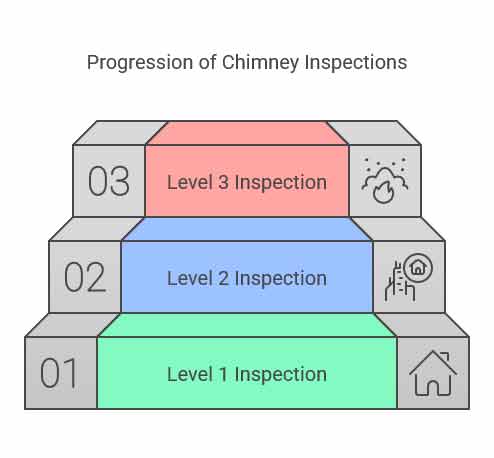
NFPA 211 defines three inspection levels and names triggers for each. Sale or transfer of property is a named trigger for Level 2. So is a change of appliance, a change of fuel, and any event that could have damaged the chimney, which in Colorado includes a hail storm or a chimney fire.
Nobody in the transaction knows that chimney's history. Somebody may have dropped in a liner without a top plate, or vented a 1990s stove insert into a clay flue sized for an open fireplace. A visual check cannot see that. A camera can. We break down the tiers in our guide to chimney inspection levels, so I will not repeat them here.
What the Level 2 gives you in a deal
In practice that means a camera scan of the full flue plus the accessible chimney in attic, basement and crawlspace. The complete scope for each level lives in the levels guide linked above.
You should get a written report with photographs and findings sorted by severity, separating safety defects from maintenance items. That distinction drives the whole negotiation.
The Colorado inspection objection period, day by day
The standard Colorado contract to buy and sell real estate gives you an inspection objection deadline and then a resolution deadline. Those dates are negotiated per contract and can be tight, and chimney companies book solid in September and October.
Here is how I would sequence it as the buyer:
- The day you go under contract, book the home inspection and the chimney inspection together. Waiting for a referral costs you a week.
- Schedule the chimney visit the same day or the next, so you are not arranging access twice.
- Confirm utilities are live. With the gas off we cannot verify a gas appliance runs, and your report comes back with a caveat.
- Ask for the written report with photos. You need a document to attach to an objection.
- Read it the day it arrives, separate safety defects from wear items, then call the inspector.
- If you object, attach a written repair estimate. An objection with a number moves faster.
- Submit before the deadline, not on it. Give the resolution period room to breathe.
If the report recommends a Level 3, which means opening concealed areas, that needs seller permission because it is destructive. Raise it immediately, because a Level 3 request inside a five day window is a hard ask.
What we commonly find, and what each finding means at the table
Most transfer inspections turn up a handful of maintenance items and one or two things that genuinely matter. Object to everything and you lose credibility; object to nothing and you inherit the bill.
Table 1. Common findings on Denver metro transfer inspections, what they indicate, and how they usually get handled.
| Finding | What it usually means | Typical path in the negotiation |
|---|---|---|
| Cracked or gapped flue tiles | Heat stress, a past chimney fire, or settling. The flue no longer safely contains combustion products. | Significant. A relining conversation, often a credit or repair before closing. |
| Heavy glazed creosote | Years of wet wood or poor draft. A fire hazard until removed. | Moderate. Stage three glaze needs specialized removal and may expose damage. |
| Deteriorated or missing crown | Freeze thaw damage. Water entering the structure from the top. | Moderate. Repair or rebuild, frequently negotiated as a credit. |
| Missing or damaged cap | Rain, snow, birds and squirrels have had open access. | Minor alone, but ask what the open flue let in. |
| Spalling brick, failed mortar | Water absorbed into masonry then frozen. The classic Colorado failure. | Tuckpointing to partial rebuild, depending how far it has gone. |
| Insert installed without a liner | An appliance vented into an oversized flue. Poor draft, fast creosote. | Significant. Correcting it means a properly sized stainless liner. |
| Water staining near the firebox | Flashing failure, crown cracks, missing cap, or absorbent masonry. | Moderate to significant. Insist on diagnosis before agreeing to a figure. |
| No clearance to framing | An original shortcut or a later remodel. A genuine fire risk. | Significant, and confirming it sometimes means opening walls. |
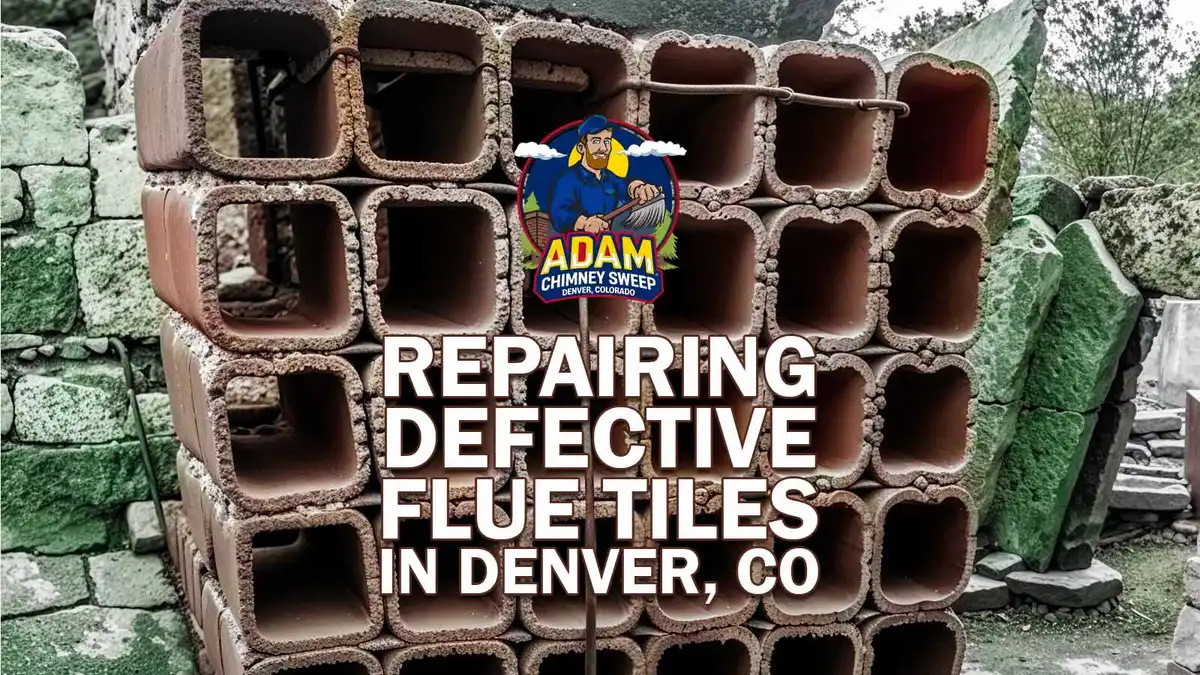
Cracked tiles most often become a real number, and our guide on repairing defective flue tiles explains why a hairline crack is not cosmetic. Water staining is rarely one cause, so read diagnosing a leaking chimney. For glaze, see preventing creosote buildup.
Who pays for the chimney inspection and who pays for the repairs
No Colorado rule assigns this. It is contract and custom. In a seller's market buyers absorb more; when inventory sits, sellers concede more.
Table 2. Who typically orders and pays for the chimney inspection in common Colorado transaction scenarios.
| Scenario | Who orders | Who pays | Repairs |
|---|---|---|---|
| Standard resale due diligence | Buyer or buyer's agent | Buyer | Negotiated in resolution, often a closing credit |
| Pre-listing, seller prepared | Seller or listing agent | Seller | Repaired before listing, or disclosed and priced in |
| As-is or estate sale | Buyer | Buyer | Seller rarely repairs. The report informs your decision |
| New build under warranty | Buyer | Buyer | Defects go to the builder, not into the price |
| Post repair verification | Buyer | Buyer, sometimes split | Confirms agreed work was done correctly |
A Level 2 with video scanning runs higher than a routine sweep because it takes longer and produces a documented report. Published national ranges vary so widely by region that quoting them here would mislead you. Our current Denver metro numbers live on the chimney and fireplace pricing page, and we quote repairs off what we see ourselves.
Playbooks for buyers, sellers and agents
Each role has a different job here, and the mistakes each one makes are different too.
For buyers
Your goal is information before the deadline, not leverage for its own sake. Order early, ask the inspector to rank findings by safety, then object with specifics and a written estimate. A sweep receipt is not an inspection, and any insert the seller added is unknown work until documented. Unpermitted installs are common on older Front Range homes, and our Colorado chimney codes and regulations guide covers what jurisdictions expect.
For sellers
Your goal is no surprises. The worst outcome is a buyer's inspector finding a cracked liner on day eight, leaving you to negotiate from behind using a stranger's report about your own house. If something needs work you can fix it and market the receipt, disclose it and price it in, or offer a credit. All three beat being blindsided, and the seller property disclosure asks about the fireplace anyway.
For agents
The chimney is one of the few systems where a bad outcome is a safety issue, not just a cost issue. Add it to the buyer checklist the way you already add a sewer scope, and suggest a pre-listing inspection on any home with a wood burning appliance built before roughly 1990. Then set expectations: a report listing twelve items is not a disaster report, so ask which two matter.
The pre-listing chimney inspection as a seller's negotiating tool
Sellers see this as one more pre-listing expense. It is the opposite. When the buyer's inspector writes the report, their side controls the framing, the timeline and the estimate. Inspect first and you control all three.
- Book it before photos are taken, ideally four to six weeks out, leaving time for repairs.
- Ask for a written report with photographs, the same document a buyer's inspector would produce.
- Sort findings into safety defects, code concerns, and cosmetic items.
- Repair the safety defects. A completed chimney repair with an invoice beats a credit of the same amount.
- Disclose the rest honestly and keep the report available for buyer review.
- Have the system swept before showings. A clean firebox photographs better.
One caution. Once you have the report, that knowledge triggers disclosure obligations. Do not order a pre-listing inspection intending to bury the results.
The documentation package to hand a buyer
A thin folder makes a buyer suspicious. A thick one closes deals. Include the dated report with photos, sweep invoices, relining documentation naming the manufacturer and installer, manuals and model numbers for any insert or gas log set, permits and final inspection cards, and warranty paperwork.
Liner documentation matters most. If nobody can say what is in the flue, a buyer's inspector treats it as unknown, and unknown costs money. Our page on chimney liner installation in Denver covers what a documented liner job looks like.
Red flags in an as-is, estate or investor sale
As-is sales are common around older Denver neighborhoods and they are not automatically bad deals. But the chimney is where as-is exposure runs highest, because the failures are concealed and the repairs are structural. What makes me want a close look:
- A fireplace visibly out of service for years, with a sealed flue and no explanation
- Fresh paint or drywall right around the chase, which often covers water history
- An insert or stove with no manual, no model plate and no permit record
- A chimney that leans, separates from the wall, or shows stair step cracking
- A crown coated in roofing tar, which patches a failure rather than repairing it
- A damper that will not move, because rust means standing water
- A wood burning appliance in a flip where nobody can name the installer
In an as-is deal the inspection is a decision tool, not a negotiating tool. You are buying information about what to budget for year one, especially where the chimney also vents a furnace.
Older Denver homes versus postwar and newer Front Range builds
What you are inspecting depends on when the house was built. Denver's stock spans 1900s brick bungalows, postwar ranches, the prefab metal fireplace era, and today's direct vent gas, all covered in our guide to Colorado chimney types. Below is only what a transfer inspection looks for in each.
Table 3. What to expect from a transfer inspection by home vintage across the Denver metro and Front Range.
| Home vintage | Typical system | What we look hardest at | Colorado note |
|---|---|---|---|
| 1900 to 1940 brick | Unlined or early clay lined masonry, several flues per stack | Whether a liner exists at all, mortar loss, separation between flues | A century of freeze thaw. Many predate liners; some were relined poorly. |
| 1945 to 1975 ranches | Clay tile lined masonry, often shared with the furnace | Tile cracking, parging, a furnace orphaned into an oversized flue | Furnace upgrades left venting oversized, causing condensation damage. |
| 1975 to 1995 with inserts | Masonry fireplace with an aftermarket stove insert | Liner sizing, connector, clearances, creosote behind the insert | Peak era for undocumented installs. Much of the nonconforming work we find sits here. |
| 1980 to 2005 factory built | Prefabricated metal firebox in a framed chase | Chase cover, flashing, cracked refractory panels, discontinued units | Flat chase covers pond snowmelt and rust through. Hail damage is routine. |
| 2005 to present | Direct vent gas, sealed combustion | Termination clearances, vent runs, glass gasket, altitude configuration | A unit configured for sea level performs poorly at 5,280 feet. |
Buyers assume a brand new chimney is fine, and usually it is, but we find framing clearance issues, chase covers set flat with no slope, and terminations that miss the 3-2-10 rule where a roofline changed during construction. Those are warranty items in year one and your problem after that.
Why Colorado chimneys fail differently
A February day can swing forty degrees, so water absorbed into brick at midday freezes hard overnight and expands. Do that a few thousand times and you get spalled faces and open joints, the masonry failure we document most at transfer. Add hail on caps every summer and monsoon rain finding every crown crack.
Altitude changes combustion and draft. Thinner air means gas units often need altitude specific orifices, and wood systems that draft fine in Kansas run sluggish here. Sluggish draft means smoldering fires, and smoldering fires mean creosote.
Frequently Asked Questions
Is a chimney inspection included in a standard home inspection?
No. Generalist standards of practice exclude the interior of a flue. Inspectors view the firebox, work the damper, and look at the chimney from the ground. That describes what was visible, not the liner.
What level of chimney inspection do I need when buying a house?
A Level 2. NFPA 211 names sale or transfer of property as a Level 2 trigger, adding video scanning of the flue plus accessible chimney in attics, basements and crawlspaces. Level 1 suits a system you already know.
Who pays for the chimney inspection in a Colorado home sale?
Whoever orders it. Buyers pay for due diligence during the objection period, sellers pay for pre-listing inspections. There is no statutory allocation, so it is contract and custom. Repairs are negotiated separately in the inspection resolution.
How long does a Level 2 chimney inspection take?
One to two hours on site for a single fireplace. Longer for a multi flue chimney, a shared furnace stack, or difficult roof access. Written reports usually follow within a day or two, so book early.
Can I ask the seller to repair the chimney after the inspection?
Yes, through the inspection objection and resolution process in your contract. You are asking the seller to complete the repair, provide a credit, or adjust the price. Attach the report and a real estimate, because documented objections get resolved.
Does an as-is sale mean I should skip the chimney inspection?
The opposite. In an as-is sale the inspection becomes a decision tool rather than a negotiating tool. You still have the right to inspect and to walk if your contract preserves it. A sweep and a full relining are very different bills.
What if the house has a gas fireplace instead of a wood burning one?
Still inspect it. Gas appliances vent combustion products and can produce carbon monoxide, so venting integrity, termination clearances and altitude setup all matter. Direct vent units fail at glass gaskets, blocked terminations and cracked logs.
Do I need a chimney inspection on a brand new build?
It is worth doing in the first year, while builder warranty coverage is live. New construction issues are workmanship rather than wear: clearance to framing, chase covers set flat, flashing details, and terminations that miss the 3-2-10 rule.
Book the transfer inspection before your deadline, not after
If you are under contract anywhere in Denver, Aurora, Centennial, Littleton or Arvada, get the chimney on the calendar the same day you book the general inspection. If you are preparing to list, get it done before the photographer arrives.
We do Level 2 chimney inspections for real estate transactions across the metro, with written reports and photographs that agents on both sides can read. Reach us at (720) 207-9232 or through our contact page, and give us your objection date up front.