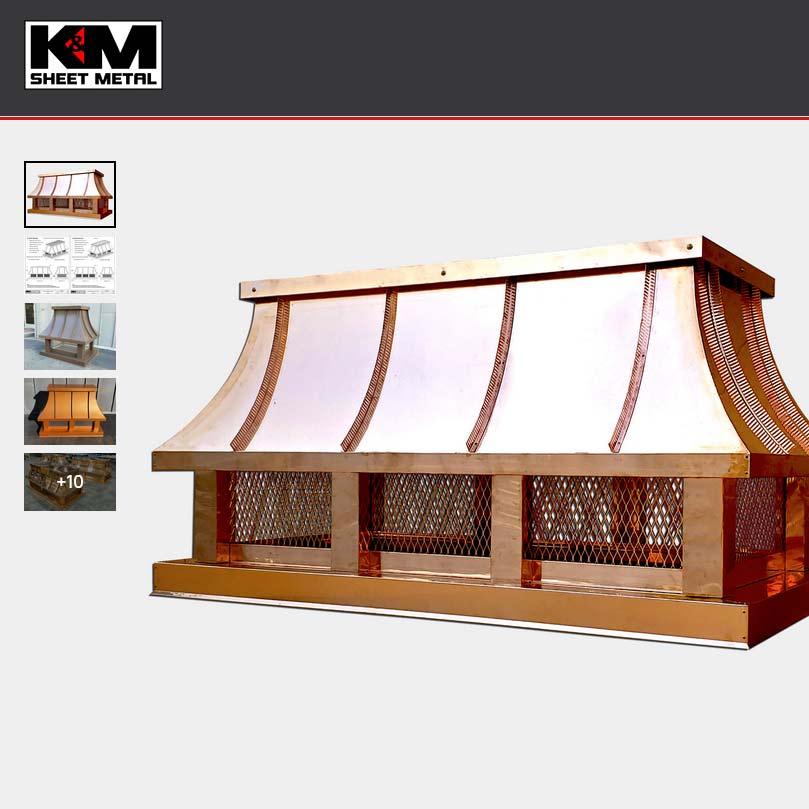
A chase cover is the flat metal lid on top of a framed chimney chase, the boxed out structure on homes with a factory built (prefab) fireplace. It is a third thing, distinct from a cap and a crown. The cap is the small hood over the flue opening. The crown is poured concrete on a masonry chimney. The cover is the pan across the entire chase top.
Chase cover replacement comes up for one reason: the builder grade galvanized pan has rusted through, and water is running down inside the chase. Rust colored streaks on the siding below the chimney top are the tell. Patching rarely holds. The fix is a new cover fabricated for your chase in stainless or copper, with real slope, a cross break, and an overhanging drip edge.
These fail early in Colorado. Freeze thaw swings, hard UV above 5,280 feet, summer hail, and monsoon rain ponding on a flat pan all shorten thin galvanized steel. A proper stainless cover is usually a one time repair.
Quick answers about chase cover replacement
These are the questions I get on the driveway before the ladder comes off the truck.
- What is it? The sheet metal top on a framed chase, with holes cut for the flue pipes.
- Who has one? Anyone with a prefab fireplace in a wood framed chase, common in metro homes built since the late 1970s. Brick chimneys have a crown.
- Why do they fail? Galvanized steel corrodes fastest where water sits, and flat covers pond water.
- Can it be patched? A coating buys a season on a cover that only weeps at a seam. Past that, it is money spent on rust.
- What replaces it? A one piece custom cover, usually 24 gauge stainless, sloped and cross broken.
- How long does it take? One visit to measure, one to install.
- Does the cap go too? Often. Same age, same cheap metal.
Do you actually have a chase cover?
Plenty of people who call about a chase cover turn out to have a crown instead, and the wrong word buys the wrong repair. The quick test is what the chimney is made of, not what is on top of it. A boxed structure wrapped in siding or stucco is a framed chase, and a framed chase has a metal cover. Solid brick or stone is a masonry chimney, and that gets a poured crown.
The chase cover
Picture your chase top as an open shoebox with flue pipes sticking out. The cover is the lid, one sheet of metal with collars cut for the pipes. It is all that stands between weather and the framing inside.
The cap and the crown, briefly
The cap is the smaller hood mounted to the flue above the cover, and it carries the spark arrestor screen. The crown is the sloped concrete slab poured across a masonry chimney top. Neither is a chase cover, and those two are the pair most often mixed up with each other: our guide to the difference between a chimney cap and a crown settles that one. Still unsure what you own? Our walkthrough of how Colorado chimneys are built starts from the curb.
Table 1. Chase cover, cap, and crown compared, and what fails on each here.
| Part | What it is | Typical material | What fails here | Found on |
|---|---|---|---|---|
| Chase cover | Pan over the full top of a framed chase | Galvanized from the builder; stainless or copper on replacement | Rust through, ponding, seams at the collars | Prefab fireplaces |
| Chimney cap | Hood and screen over the flue | Galvanized, stainless, copper | Rusted screen, hail dents, wind lift | Prefab and masonry |
| Chimney crown | Concrete wash poured on brick | Concrete or mortar | Freeze thaw cracking, spalling, no drip edge | Masonry only |
| Storm collar | Band sealing the pipe at the cover | Stainless with high temp sealant | Dried sealant, open gap at the pipe | Any metal flue |
Why builder grade galvanized chase covers rust out in Colorado
Nearly every builder installed cover is light galvanized steel, often 26 or 28 gauge, with a thin zinc coating. Zinc protects steel by sacrificing itself, which works fine until the zinc is gone. Then the steel is bare and the clock runs fast.
Our climate speeds that up. Sun at altitude is stronger, and a dark pan swings from freezing at dawn to hot by noon. Water seeps into a seam, freezes overnight, and pries it wider, dozens of times a winter. Hail cracks the coating at every dent, then monsoon rain sits in the dimples. Flue condensate finishes the job, which is why the first pinhole is almost always beside a pipe. On chimney repair work in Denver, the collars are where the screwdriver goes first.
Standing water, correct slope, and the cross break
A chase cover fails wherever water sits longest. Shed it fast and even ordinary steel lasts a while. Let it pond and the seams weep. The difference is geometry, not price.
Ponding is the root problem
A flat pan is never truly flat. Snow load, hail, and a roofer walking across it leave a low spot, and every rain fills it. In winter that puddle freezes, expands, and pushes the spot lower. That is the sag you can see from the yard.
Slope and the cross break
A good cover is folded so the center ridge sits higher than the four edges, a fold fabricators call a cross break. Water leaves in four directions instead of pooling, and the fold stiffens the sheet against Front Range wind.
Overhang and drip edge
The skirt laps over the outside of the chase, and its bottom edge should be hemmed into a drip edge that kicks water clear of the siding. Without that kick, water wicks back under the skirt and rots the chase wall.
What a correctly built cover has
- One piece construction with folded corners, not four pieces caulked together
- A cross break or defined slope to all four edges
- A skirt long enough to lap the chase, hemmed into a drip edge
- Collars sized to the pipes, not oversized holes filled with sealant
- Stainless fasteners and room for thermal movement
Stainless, copper, or galvanized: picking the metal
This is where the money decision sits. Getting a crew and ladders on your roof costs the same whatever metal goes down, so upgrading to a lifetime material is a smaller share of the total than most people expect. For real figures on your chase, see our chimney and fireplace pricing page.
For most Denver metro homes I recommend 304 stainless in 24 gauge. It handles UV and freeze thaw, takes a hail hit without cracking a coating, and never needs paint. Copper is the upgrade when the chimney is visible from the street.
Table 2. Chase cover materials compared, with notes for Front Range conditions.
| Material | Thickness | Pros | Cons | Colorado notes |
|---|---|---|---|---|
| Builder grade galvanized | 26 to 28 gauge | Cheapest, easy to form | Zinc wears off, then rusts fast; dents and sags | We commonly pull these at eight to fifteen years |
| Painted or coated steel | 24 to 26 gauge | Color matched to siding | Chips at every hail dent and screw; rust starts underneath | Only as good as its worst hail dent |
| 304 stainless | 24 gauge | Long life, no coating to fail | Higher cost, can stain where water ponds | The default recommendation for most metro homes |
| 316 stainless | 24 gauge | Best resistance to flue condensate | Highest stainless cost, rarely needed | Worth discussing on a heavily used wood burner |
| Copper | 16 or 20 ounce | Very long life, patinas | Soft, dents from hail more readily, premium cost | Keep it off bare aluminum to avoid galvanic corrosion |
Signs your chase cover is failing
Chase covers fail quietly for a couple of years, then a spring storm pushes water somewhere you notice. The early warnings are visible from the ground.
Rust streaks are the classic tell: orange brown stripes down siding or stucco below the chimney top. Water in the firebox after rain is the second most common call, and homeowners usually blame the roof first. A musty smell after a wet week is the third.
Table 3. Symptom, likely cause, and the usual fix for a failing chase cover.
| What you see | Likely cause | What it usually takes |
|---|---|---|
| Rust streaks down siding below the chimney top | Cover is rusting and shedding oxide with every rain | Full replacement in stainless or copper |
| Water in the firebox after rain, roof is sound | Pinholes, open seams, or a failed flue collar | Replacement plus a new storm collar and sealant |
| Visible dip or puddle on top after a storm | Flat pan has deformed and now ponds water | Replacement with a cross break |
| Peeling paint or soft trim at the chase top | No drip edge, so water runs back under the skirt | New cover with a hemmed drip edge, plus trim repair |
| Dented cover after a hail season | Thin metal with a cracked coating at each dent | Replacement; document it for insurance |
A ground level check you can do yourself
- Step across the street and look at the chase top with binoculars or a zoomed phone camera.
- Look for orange staining on the metal, on the cap, and on the siding beneath it.
- Check whether the top looks flat or peaked. A flat top on an older home is a replacement candidate.
- After the next rain, open the fireplace and look for water, damp ash, or a fresh drip line.
- Have it verified from the roof; these are hints, not a diagnosis.
If water is showing up inside and you are not sure where it starts, work through our breakdown of the common causes of a leaking chimney first. Flashing and a missing cap leave the same stains.
Measuring for a custom chase cover
There is no stock chase cover that fits well. Chases are framed on site, they are rarely square, and flue locations vary. Every cover is cut and folded for one chimney.
- Measure the outside of the chase top, front to back and side to side, at both ends of each run.
- Measure both diagonals across the opening to see how far out of square the chase is.
- Count the penetrations. Many chases carry a flue plus a vent pipe, and both need a collar.
- Measure each pipe diameter and the distance from pipe center to two reference edges.
- Set collar height, since taller collars keep water further from the seam.
- Set skirt depth, usually two to three inches, based on the siding detail.
- Probe the top plate and framing for rot before ordering any metal.
- Photograph everything, including the cap, so the shop sees the same chimney you do.
That rot check matters. If the framing under the old cover is soft, the repair is now carpentry plus metal, and nobody wants to learn that on install day. It is also why I will not quote from a phone photo.
The replacement process, from teardown to new cap
A straightforward chase cover replacement is one trip once the metal is fabricated. Here is how it runs on a typical two story with a framed chase.
- Set up roof access safely and protect the roofing at the chase base.
- Remove the cap and storm collar and set them aside for inspection.
- Cut the old sealant, back out the fasteners, and lift the rusted cover off.
- Inspect the top plate, framing, and insulation, probing for rot anywhere stained.
- Repair soft framing and re establish a sound, level nailing surface.
- Dry fit the cover and confirm the collars line up and the skirt laps evenly.
- Fasten with stainless screws and sealing washers, leaving room for thermal movement.
- Seal the collars and fit a new storm collar tight to each pipe.
- Install the cap and confirm the spark arrestor screen is intact.
- Run water over it, watch where it goes, and photograph the finished work.
Since we are already at the top of the flue, this is the moment to handle cap work. If yours is missing, dented, or has a rotted screen, see our page on chimney cap repair and installation.
What sits under the cover, and what has to clear it
A chase cover is the roof of a small building that happens to have a chimney in it. Underneath sit a plywood top plate, framing, sometimes insulation, and chase walls carrying siding. Water past the cover soaks sheathing and eventually stains drywall a floor below.
Above the cover, the flue has to reach far enough to draft. The rule of thumb is 3-2-10: at least three feet above where it exits, and two feet above anything within ten feet. Thin air at our elevation already gives a chimney less to work with, so I do not give away flue height during a cover swap.
Getting the chase top actually looked at
The chase top is the part of the chimney most often inspected from the driveway, which is exactly why rusted covers get missed. Rust at a flue collar does not show from the ground. Ask for photographs taken from the roof rather than a line saying the chimney was viewed from below, and if the cover has been weeping for a season or two, ask whether water has reached the liner as well.
Which inspection covers that, and what the local rules ask of you, are separate subjects with their own guides: see the three chimney inspection levels and chimney laws and regulations in Colorado. To have the cover, the collars, and the flue looked at on one visit, book a chimney inspection in Denver.
Keeping a new chase cover healthy in Colorado weather
Stainless is close to maintenance free, but the environment around it is not. Most of what shortens a good cover's life is debris collecting on it. Pine needles pack around the collars and hold water.
- Have debris cleared off during annual service instead of letting it compost around the collars.
- Check the cover and cap after every serious hail event, and photograph damage the same day.
- Watch the siding below the chimney each spring for new staining.
- Do not pressure wash the cover or cap; you will drive water past the collars.
- Renew the storm collar sealant when it hardens, since it fails long before the metal.
Pair that with the rest of your seasonal routine. Our winter chimney safety checklist covers what to run through before the first cold snap. If you burn wood, the metro area also restricts burning on Air Quality Action Days.
Frequently Asked Questions
What is the difference between a chimney chase cover and a chimney cap?
The cover is the large pan over the entire top of a framed chase, with holes cut for the flue pipes. The cap is the smaller hood above it, mounted to the flue, carrying the spark arrestor screen.
How long should a chase cover last in Colorado?
It depends on the metal and the slope. Builder grade galvanized commonly needs replacing around eight to fifteen years here, sooner after a bad hail year. Good stainless should outlast your time in the house.
Can I just seal or paint a rusted chase cover instead of replacing it?
Only if the pan holds its shape and weeps at a seam rather than leaking through. Then a coating buys a season. If it ponds, sags, or has pinholes, coating traps moisture and hides rot below.
Why is water getting into my firebox when the roof is not leaking?
On a prefab chimney the usual answer is the chase cover, most often a pinhole or open seam near a flue collar. Water runs down the outside of the pipe and drips into the firebox. A missing cap does the same.
What metal and gauge should a replacement chase cover be?
For most Denver metro homes, 24 gauge 304 stainless, fabricated as one piece with folded corners. That thickness resists denting and holds a cross break without oil canning in wind.
Does a chase cover really need a cross break?
Yes. It raises the center so water sheds to all four edges instead of pooling, and it stiffens the sheet against snow load. A modest rise separates a surface that dries in an hour from one that stays wet.
Do I need a new chimney cap when the chase cover is replaced?
Not always, but usually it makes sense. The cap is the same age and the same builder grade metal, and it has to come off anyway. Doing both means one trip and one set of sealed collars.
Will a new chase cover remove the rust stains already on my siding?
No. Replacing the cover stops new staining but does not clean old streaks. Existing marks on siding or stucco need separate cleaning. Do the cover first, or the stains just come back.
Ready to get the top of your chimney handled?
If you have rust streaks on your siding, water in the firebox, or a chase cover original to a house built in the 1980s or 1990s, the next step is getting eyes on top of the chase. We measure, check the framing underneath, look at the cap and flue, and give you a written scope before anything is ordered.
Call the shop at (720) 207-9232 to set up a look, or send details through our contact page with a photo of the chimney from the street. We are based in Aurora at 12894 E Villanova Dr and work throughout the Denver metro area and the Front Range. A chase cover is a small part of the house that quietly protects a large one, and it is worth doing once, correctly.