There are four chimney liner types you will run into in a Colorado home: clay tile, stainless steel (rigid or flexible, in a few alloys), aluminum, and cast in place. Which one belongs in your chimney depends on what you burn and what shape the masonry is in today, not on which product has the best brochure.
The short version: intact clay tile is fine for an open wood fireplace. Stainless steel is the answer for most relines, with 316Ti alloy for anything burning wood or pellets and 304 reserved for dry gas applications. Aluminum belongs only on certain listed gas appliances, never wood. Cast in place is the specialty choice when the masonry itself is failing and needs a new structural core.
This guide is the materials decision. For cost strategy, read our cheapest way to reline a chimney guide, and if you already know you need a liner, our chimney lining service page covers how we do the work. A liner has to survive heat, acid, and moisture, and in Denver, where thin air at 5,280 feet already weakens draft and the chimney swings through freeze and thaw dozens of times a season, the wrong material fails faster than it would in a milder climate. NFPA 211, the national standard for chimneys and vents, calls for a liner in masonry chimneys serving solid fuel appliances and a properly sized listed vent or liner for gas, so the question is rarely whether to line, it is which material.
Clay Tile Liners: The Original Standard
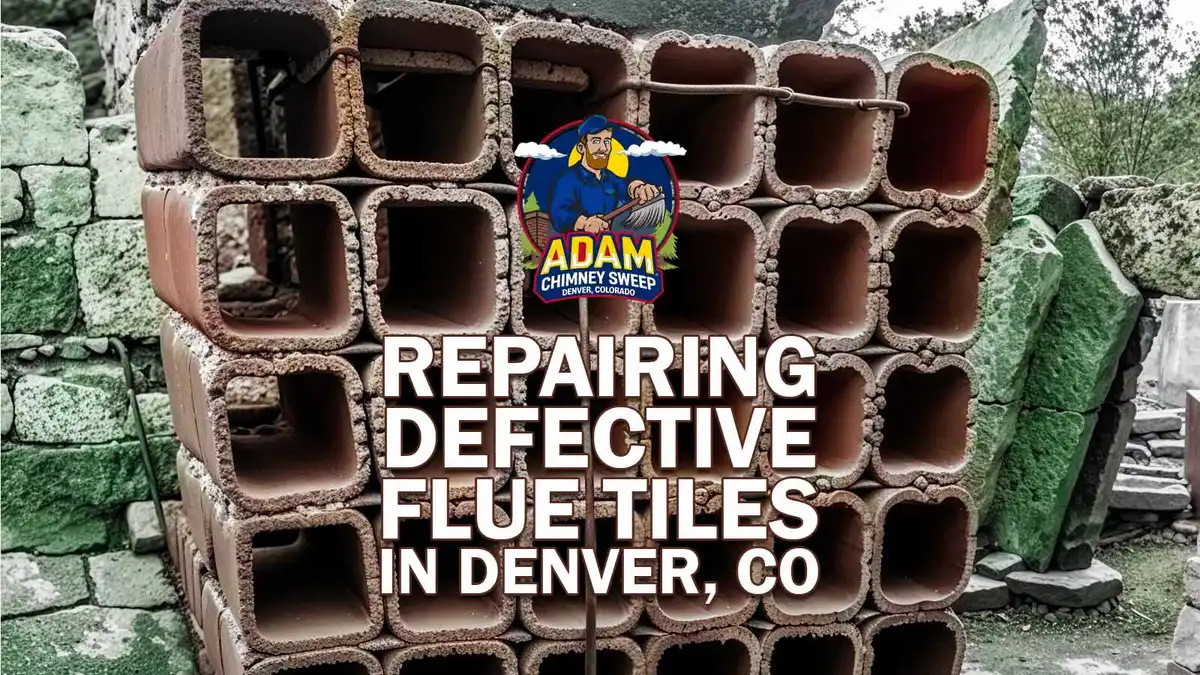
Clay flue tile is fired ceramic, usually in two foot sections, stacked inside the chimney as it is built with refractory mortar at each joint.
Most Denver brick homes from the early 1900s through the 1990s have clay tile flues. It is a good material: it shrugs off the normal heat of a wood fire, it does not corrode from wood smoke acids, and an intact flue with sound joints can last many decades. When we find unbroken tile with tight joints during a Level 2 camera inspection, we tell the homeowner to leave it alone.
Why a Cracked Tile Cannot Be Patched From Inside
Clay tile is a construction material, not a retrofit material: it goes in from the bottom up while the mason lays brick around it, so replacing a broken tile mid flue means opening the chimney wall. Chimney fires, freeze-thaw cycles, and decades of acidic condensate crack tiles and open joints all the way through, which is why NFPA 211 treats a flue with cracked, spalled, or missing tiles as unsuitable for use until it is relined or the tiles are replaced. Which repairs are legitimate, and what a camera actually finds, is covered in our guide on repairing defective flue tiles.
Stainless Steel Liners: Rigid vs Flexible
Stainless steel is the workhorse of the reline trade because it installs from the top of a finished chimney, handles every common fuel when the right alloy is chosen, and is listed to UL 1777, the safety standard for chimney liners.
Rigid Stainless
Rigid liner is smooth walled pipe in straight sections joined with screws or clamps. It has the smoothest interior, so the best draft and the least creosote grip. The catch is that it only fits a straight flue. A chimney with an offset, common in older Denver homes, cannot take rigid pipe without cutting into the masonry.
Flexible Stainless
Flexible liner is corrugated stainless formed from a continuous strip locked or welded into a tube. It bends around offsets, comes in one length with no joints inside the flue, and installs in a fraction of the time. The tradeoff is a corrugated interior that adds a little friction and holds slightly more soot. For a typical Front Range reline, especially a wood insert, this is what goes in. The install generally runs like this:
- Camera inspect and measure the flue, and confirm the appliance outlet size. Our flue size and appliance match guide explains why this step decides whether the stove drafts.
- Sweep the flue, because a liner should never go in over loose creosote.
- Remove or notch the old damper plate so the liner has a clear path into the firebox.
- Wrap or pour insulation where the listing and the chimney clearance call for it.
- Feed the liner from the roof, connect it with a listed adapter, and secure the top with a plate and cap.
- Seal the top plate against water, test the draft with the appliance running, and photograph the connections.
304 vs 316 vs 316Ti: Why the Alloy Number Matters
Two stainless liners can look identical and behave completely differently after five heating seasons.
- 304 stainless is the basic chromium and nickel grade. It resists heat well and holds up to dry gas exhaust, but it is more vulnerable to chlorides and to the acids that form when flue gas condenses.
- 316 stainless adds molybdenum, which sharply improves resistance to acids and chlorides. Wood smoke, pellet exhaust, oil exhaust, and any flue that runs cool enough to condense produce exactly those compounds.
- 316Ti is 316 with a small titanium addition that stabilizes the alloy against corrosion at the grain boundaries after repeated heating. For a liner that will see the high heat of a wood stove, an occasional overfire, and acidic creosote sitting on it all summer, 316Ti is the grade that holds up. It is what we specify for wood and pellets.
- AL29-4C is a specialized ferritic alloy for high efficiency condensing gas appliances, whose flue gas is cool and wet enough that even 316 can suffer.
Colorado gives you an extra reason to lean toward 316Ti for wood. At altitude, combustion is a little less complete and flue temperatures a little lower, so more creosote and acidic condensate form than the same stove would produce at sea level.
Aluminum Liners: Gas Only, and Only Some Gas
Aluminum flexible liner is thin, light, and inexpensive. It exists for one purpose: venting certain listed natural draft gas appliances with relatively dry, moderate temperature exhaust, such as some gas log sets and older gas furnaces and water heaters.
Aluminum is never acceptable for wood, pellets, coal, or oil. It melts at a temperature a wood fire can reach, it has no resistance to the acids in solid fuel smoke, and it is not listed for those fuels. We have pulled aluminum liners out of Denver chimneys that a previous owner ran a wood insert through, and they looked like crumpled foil with holes you could put a hand through.
Even for gas it has limits. Condensing appliances produce acidic condensate that eats aluminum quickly, and because the appliance is often in the basement, problems go unnoticed until a carbon monoxide alarm sounds. Our furnace and water heater chimney venting guide covers why an orphaned water heater on an oversized flue is a common Denver problem.
Cast in Place Liners: When the Chimney Needs a New Core
A cast in place liner is not a pipe. It is a cement based insulating refractory mix, either pumped around an inflated rubber former running the length of the flue or drawn up the flue around a vibrating bell. When it cures, the chimney has a new, seamless, round flue bonded to the old masonry, with insulating mass filling every crack, gap, and missing tile behind it.
That bonding is the point. A stainless liner is a new pipe hanging inside a tired chimney; a cast in place liner turns the tired chimney into a monolithic structure again. If a camera shows tiles missing entirely, mortar joints washed out, brick separated inside the chase, or fire damage that cost the chimney its integrity, cast in place restores structural strength that no metal liner provides. It also insulates well and handles all fuels including wood.
The tradeoffs are real. Fewer crews perform it, it is generally the most expensive lining method, it cannot be removed once cured, and it narrows the flue by the thickness of the cast material. When the masonry is sound and only the tile is cracked, stainless does the job for less. When the masonry itself is the problem, compare it against our chimney repair options and a partial rebuild.
The Big Comparison: Liner Materials Side by Side
Table 1. Chimney liner materials compared by fuel compatibility, typical lifespan (industry ranges, not guarantees), Colorado durability, repairability, insulation, and typical use.
| Liner | Fuels | Typical lifespan | Freeze-thaw and acid resistance | Ease of repair | Insulation options | Typical use case |
|---|---|---|---|---|---|---|
| Clay tile | Wood, gas, oil | Many decades when intact | Good against acid; poor against freeze-thaw once joints open; cracks in chimney fires | Very hard; cannot be patched from inside | None | Original construction; open fireplaces with sound tile |
| Rigid stainless (304 or 316Ti) | Wood, gas, oil, pellet by alloy | Typically 15 to 25 years or more | Excellent; 316Ti best against acid | Moderate; sections can be replaced | Poured or wrap | Straight flues; freestanding stoves; best draft |
| Flexible stainless 304 | Gas, dry applications | Typically 10 to 20 years | Good heat resistance; weaker against condensate and chlorides | Easy; pull and replace | Wrap or pour | Gas inserts and gas logs on natural draft appliances |
| Flexible stainless 316Ti | Wood, pellet, coal, oil, gas | Typically 15 to 25 years or more | Excellent against acid, chlorides, and repeated heating | Easy; pull and replace | Wrap or pour | Wood inserts; offset flues; the default Colorado reline |
| Aluminum | Certain listed natural draft gas appliances only | Typically 5 to 15 years | Poor; corrodes in condensate; melts in a wood fire | Easy to replace, hard to clean without damage | Usually none | Budget gas venting where the listing allows it |
| Cast in place | Wood, gas, oil, pellet | Often marketed at 50 years | Excellent; seals and insulates the masonry | Difficult; cannot be removed | Insulating by nature | Structurally weak or fire damaged masonry; historic chimneys worth saving |
316Ti flexible stainless covers the widest range of situations at a reasonable cost, which is why most Denver homeowners end up with it.
How Your Appliance Drives the Choice
The appliance decides the temperature, moisture, and acidity of what goes up the flue and the diameter the flue must be, so it decides the liner.
Table 2. Typical liner choices by appliance type in Colorado homes, with the reason behind each.
| Appliance | Usual liner choice | Why | Watch out for |
|---|---|---|---|
| Open masonry wood fireplace | Keep intact clay tile; 316Ti stainless or cast in place if tile is damaged | Needs a large flue and sees wide temperature swings | Undersizing the liner, which kills draft at altitude |
| Wood burning insert | Insulated 316Ti flexible stainless, full length to the top | Hot, acidic, creosote heavy exhaust through a small outlet | Slammer installs with no liner; uninsulated liners in exterior chimneys |
| Gas insert or gas logs | 304 or 316 stainless, often a two liner co-linear kit for direct vent inserts; aluminum only where the listing allows | Cooler, wetter exhaust that condenses | Running gas through an old oversized clay flue, which condenses and stains |
| Pellet stove or insert | 316Ti stainless | Fly ash and acidic, low temperature exhaust | Aluminum or 304, which pit quickly |
| Furnace or water heater | Stainless sized to the appliance; aluminum only for listed natural draft units; AL29-4C for condensing appliances | Continuous cycling and wet exhaust | Skipping the resize after a furnace upgrade |
Every wood insert we install gets a full length insulated 316Ti liner; our chimney liner insulation guide explains why insulation in a cold exterior chimney separates a stove that runs clean from one that glazes its flue every winter. A direct vent gas insert uses two liners, one for combustion air and one for exhaust. And when a new high efficiency furnace vents out the side wall in PVC, the water heater is left alone on a flue far too large for it, where its exhaust condenses and rots the flue from inside. A correctly sized stainless liner is the fix, and it is among the most common liner jobs we do in Aurora and Centennial.
Listing, Warranty, and Why a Liner Is Only as Good as Its Installation
A stainless liner sold for solid fuel should be listed to UL 1777. That listing is tested as a system: the liner, the insulation, the connectors, the top plate, and the required clearance to combustibles, installed a specific way. Skip the insulation the listing requires or connect it with a hardware store adapter, and the listing no longer applies. Neither does the warranty in most cases.
Many manufacturers offer long warranties, some lifetime, on the material itself. Read the conditions. They typically require professional installation, an annual inspection and sweep, use only with the fuels the alloy is rated for, and no chimney fires, and they do not cover the labor to replace the liner. The warranty is a statement about the alloy; installation quality decides whether you ever need it. Front Range wind pushing cold air down an uninsulated flue, and summer hail and monsoon rain finding a gap at the top plate, are the two local ways a good liner gets ruined. Our pricing page lays out how we quote lining work so you can compare like for like.
A Decision Walkthrough You Can Do at the Kitchen Table
Work through these in order.
- What do you burn, or plan to burn? Wood or pellets rule out aluminum and point to 316Ti stainless or cast in place. Gas opens up 304 stainless and, where the listing allows, aluminum. A condensing appliance points to AL29-4C.
- What did the camera find? Intact tile with tight joints means you may not need a liner at all. Cracked tiles with sound brick means stainless. Missing tiles, washed out joints, or fire damaged masonry puts cast in place on the table.
- Is the flue straight or offset, and is it on an exterior wall? Straight allows rigid stainless; an offset means flexible stainless or cast in place. An exterior chimney needs an insulated liner.
- Will the required diameter plus insulation fit? If not, you are choosing between breaking out the old tile, cast in place, or a different appliance.
- Who is installing it, and will they document it? Ask for the UL listing, the alloy, the insulation plan, and photos of the finished top and bottom connections. If those answers are vague, keep shopping.
Frequently Asked Questions
What is the best chimney liner material for a wood burning fireplace or insert?
For a wood insert, an insulated 316Ti flexible stainless liner is the standard choice because it handles high heat and acidic creosote and installs through an offset flue. For an open fireplace with intact clay tile, the best liner is the one already there; if the tile is cracked, 316Ti stainless or cast in place are the proper options.
Can I use an aluminum liner for my wood fireplace?
No. Aluminum is only listed for certain natural draft gas appliances. It melts at wood fire temperatures and corrodes quickly in solid fuel exhaust. Using it for wood is a fire hazard.
Can a cracked clay flue tile be repaired without relining?
Not from inside the flue in a way that restores it. A crack or open joint runs through the tile wall, and coatings applied from inside do not reconnect it or bond reliably to a soot glazed surface. Replacing individual tiles means opening the chimney wall, so a stainless reline is the practical repair for most homes.
How long does a stainless steel chimney liner last?
A correctly installed and maintained 316Ti liner typically lasts 15 to 25 years or more. Lifespan drops fast with chimney fires, missing insulation in a cold chase, water intrusion from a bad cap, or burning the wrong fuel for the alloy.
When does a cast in place liner make more sense than stainless?
When the masonry itself is failing: tiles missing, joints washed out, brick separated, or fire damage that compromised the structure. Cast in place bonds to the old masonry and restores structural strength while insulating the flue. When only the tile is cracked, stainless does the job for less.
Does a gas insert need a chimney liner?
Yes. Direct vent gas inserts use a two liner co-linear stainless kit for intake and exhaust. Natural draft gas logs venting through an old oversized clay flue tend to condense and stain, so a correctly sized liner is strongly recommended.
Not Sure What Is Inside Your Flue? Start With a Camera
Every liner decision starts with a look at the tile that is already there. If you are weighing an insert, dealing with a smoky fireplace, or an inspector flagged your flue during a home sale, book a Level 2 camera inspection. We will show you the footage and lay out the material options that fit your chimney and appliance. Call the crew at (720) 207-9232 and we will get you scheduled across Aurora, Denver, and the Front Range.