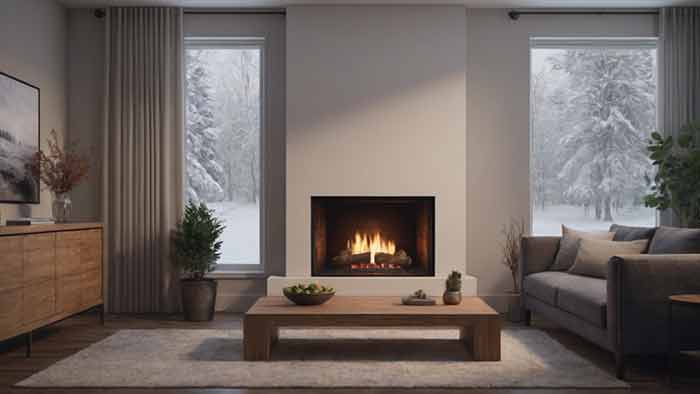
A gas fireplace annual service is a preventive tune-up, not a repair call. A technician takes the unit apart to the level the manufacturer intends, cleans the burner and pilot assembly, checks the glass and its gasket, tests the safety components with a meter, confirms the logs sit exactly where the manual says, inspects the vent out to the termination cap, and takes a carbon monoxide reading while the fire runs.
It matters because a gas fireplace is a combustion appliance living inside your house. It can light on the first click and still be running rich, venting poorly, or carrying a cracked gasket that lets flue gas into the room. Those problems do not announce themselves. A yearly service catches them while they are cheap and boring.
This guide covers what the service includes on our trucks, what you can do yourself between visits, and how Colorado's altitude, dust, wind, and snow change the picture. If your fireplace will not light at all, start with our gas fireplace pilot light troubleshooting guide and come back here once it is running.
Why a Gas Fireplace That Lights Fine Still Needs Service
Gas owners often assume clean fuel means nothing to maintain. Gas burns much cleaner than wood, but cleaner is not clean, and the fireplace has more going on than the flame.
- Combustion byproducts still form. Natural gas and propane produce water vapor, carbon dioxide, small amounts of carbon monoxide, and, when a flame touches a log or the air mix is off, soot. Over a season those coat the glass, logs, and firebox.
- Dust and pet hair collect in the burner. Front Range dust, drywall grit, and pet hair settle in the burner ports and around the pilot and change how the flame behaves.
- Spiders like the pilot hood. A web the size of a pinhead inside the pilot tube can distort the flame enough that the thermocouple or thermopile never gets hot enough to hold the valve open.
- Gaskets and glass age. On a direct vent unit the glass and its rope gasket are the seal between the combustion chamber and your living room. Gaskets compress and crack, and a failed seal lets flue gas into the room.
- Carbon monoxide has no smell. A unit can produce elevated CO for months with no visible sign. The only way to know is to measure. Our carbon monoxide and chimney safety guide explains why tight Colorado homes are at particular risk.
The Annual Service Sequence, Step by Step
Every brand has its own manual, and the manual wins over any generic list. That said, a proper service follows the same shape on almost every unit we see, from a 1990s builder-grade box in Highlands Ranch to a modern linear unit in Central Park.
- Visual and gasket inspection. The technician runs the unit, watches the flame pattern, and looks for staining and heat damage. After cool-down, the glass gasket is checked for compression, cracks, and gaps at the corners.
- Glass removal and cleaning. The glass frame comes off and the ceramic glass is cleaned on both sides with a cleaner made for gas fireplace glass, never an ammonia window spray, which can etch the surface.
- Ember and log removal per the manual. Logs, embers, and decorative media come out and are set aside in order, which is the only way to reach the burner.
- Burner and pilot assembly cleaning. Burner ports are brushed and vacuumed. The pilot hood, thermocouple or thermopile, and igniter electrode are cleaned with compressed air and a soft brush, and the pilot orifice is checked for webs.
- Millivolt test. With the pilot lit, a multimeter reads thermocouple or thermopile output, open circuit and under load, against the values in the service manual. A weak reading is the most common cause of a fireplace that lights and then drops out, and the typical service ranges are tabled in our pilot light guide linked above.
- Valve and ignition operation. The gas valve is cycled through pilot and main burner, and wall switch, remote, and thermostat inputs are tested. On intermittent pilot units, the ignition module and flame sensing are checked for clean, repeatable lights.
- Fan and blower cleaning. Blower cages pack with dust and pet hair, which cuts airflow and can overheat the motor. The cage is cleaned and the speed control and snap disc are tested.
- Venting and termination cap check. Inside, the vent collar and visible pipe are inspected for separation, corrosion, and slope. Outside, the termination cap is checked for blockages, hail damage, clearances, and insect or bird activity.
- Carbon monoxide reading. With the unit reassembled and running, a combustion analyzer reads CO in the flue gas and a separate meter checks ambient CO in the room, which should read zero. Flue readings are compared against the manufacturer's expectations for that model.
- Log placement verification. Every log and ember piece is confirmed against the manual's diagram, then the flame is watched for ten minutes to confirm no impingement and no soot.
A thorough service on a standard unit takes roughly an hour to ninety minutes, longer for linear units with lots of media or tight built-ins. Pricing depends on the unit and what we find, so please check our chimney and fireplace pricing page rather than guessing from a number in an article.
The White Film on the Glass and What It Is
Almost every gas fireplace develops a cloudy white or gray haze on the inside of the glass. It is not smoke residue and it is rarely a sign of failure. The film is mostly mineral deposits carried in the combustion gases and in the water vapor that condenses on the glass every cold start. Sulfur compounds in the gas, along with trace minerals from the logs, ember material, and the firebox paint curing during the first burns, end up as a thin crust, faster on new units and fresh log sets.
What matters is how it is cleaned. Ceramic glass can be etched, and a heavy film that is reheated over and over can bond to the surface. Use a cleaner labeled for gas fireplace glass on cold glass with a soft cloth. Household ammonia cleaners can leave a permanent haze, and the wood ash paste people use on wood stove glass can scratch a gas unit's glass.
If the film comes back black rather than white, that is soot, which on a gas unit means a flame is hitting something it should not, usually a log out of position. Our soot versus creosote guide covers the difference between soot and the deposits a wood fire leaves. On a gas unit, black soot is a stop-and-call signal.
Log and Ember Placement: Why Moving the Logs Matters
The logs in a gas fireplace are not decorative in the way a mantel is decorative. Their position is engineered around the burner ports so the flame passes beside and behind them without touching, which is why the manual includes a diagram.
When a log gets bumped or stacked differently after a cleaning, the flame can impinge on the ceramic. Flame touching a cooler surface cannot finish burning, so it produces soot and carbon monoxide. The soot shows up on the glass. The CO does not show up at all unless someone measures it. A log that rolls forward during a homeowner cleaning is enough to cause it.
Ember material matters too. The glowing bits, usually rock wool or vermiculite, should be spread thinly where the manual shows, never piled or pushed over the ports. During the service we confirm every log is on its locating pins, no log lies across a port row, cracked logs are noted, and after ten minutes no dark tips appear where the flame meets a log.
If you are weighing a log set against an insert or a built-in, our gas logs versus insert versus built-in comparison explains how each handles logs and venting.
The Venting Check: Direct Vent, B Vent, and Vent Free
Table 1. How the annual venting check differs by gas fireplace vent type.
| Vent type | How it breathes | What the service checks | Common Colorado problem |
|---|---|---|---|
| Direct vent | Sealed glass front; coaxial or twin pipe pulls outside air in and pushes exhaust out | Glass gasket seal, pipe joints, termination cap clearance and screen, debris in the intake | Snow or ice against a low wall termination, wasp nests in the intake, aged gaskets |
| B vent (natural vent) | Open front; uses room air, exhaust rises through a double-wall metal flue to the roof | Draft at the hood, flue continuity, roof cap and storm collar, spillage test at startup | Downdraft in Front Range wind, bird nests in the cap, cold flue slow to draft in thin air |
| Vent free | No vent; burns room air and releases byproducts into the room, protected by an oxygen depletion sensor | ODS pilot cleanliness, burner ports, log placement, room size and ventilation, ambient CO and moisture | Dust on the ODS causing nuisance shutdowns, window condensation, local code limits |
Direct vent units are the most common in newer Denver metro homes, and the termination cap is the piece homeowners forget. Wall caps sit low enough that a snowbank or a stack of firewood can block them, and roof caps collect hail dents and pine needles. A blocked termination means the sealed system cannot exhaust properly, and the unit shuts down or runs poorly. B vent units share a lot with furnace venting, including the risk of spillage on a cold start before the flue warms. Vent free units are allowed in some Colorado jurisdictions and restricted in others, so check with your local building department before installing or keeping one.
Altitude, Thin Air, and Orifice Sizing
A gas fireplace tested at sea level does not behave the same way at 5,280 feet, let alone in Evergreen or Conifer, because thinner air means less oxygen reaching the burner, so a burner on a sea level orifice runs rich up here, and rich combustion means more soot and more CO. Manufacturers publish a high altitude orifice or conversion kit for elevations above a stated baseline, with the exact size coming from the altitude chart for that model and fuel, so during the service the technician confirms the installed orifice matches the chart for your elevation and fuel. What a missed conversion looks like, and why it gets mistaken for a pilot fault, is covered in our gas fireplace pilot light guide, and draft in thin air more broadly in our guide to understanding your chimney in Colorado homes.
What You Can Do Versus What Needs a Technician
There is real homeowner maintenance on a gas fireplace, and there are jobs involving gas, sealed combustion, or safety components where a mistake has consequences. Test your CO alarm on your own schedule; the rest splits like this.
Table 2. Gas fireplace maintenance tasks split between homeowner work and technician work.
| Task | Homeowner | Technician | Why |
|---|---|---|---|
| Vacuum dust from the firebox floor and louvers, unit cold | Yes | Also done at service | Low risk, no gas components touched |
| Clean the inside of the glass | Only if the manual shows frame removal | Yes | A damaged gasket on a direct vent unit lets flue gas into the room |
| Reposition logs and embers | No | Yes | Wrong placement causes soot and raises CO |
| Clean burner ports, pilot, and thermopile; millivolt test | No | Yes | Requires removing media, a meter, and knowing expected readings |
| Combustion analysis and flue gas CO reading | No | Yes | Requires a calibrated analyzer |
| Orifice changes for altitude or fuel | No | Yes | Gas work, and the wrong orifice is a safety issue |
A quick vacuum of the louvers and a glance at the termination cap each month during the season prevents a lot of nuisance shutdowns.
How Often, and When You Should Not Wait
Once a year is the standard. The best timing in Colorado is late summer or early fall, before the first cold snap sends everyone reaching for the switch at once. If we find a failing thermopile or a bad gasket in September, the part arrives before you need the heat.
Some situations should not wait for the calendar. If you notice any of the following, shut the unit down and book a visit. In rough order of urgency:
- A CO alarm sounding, or a headache that clears when you leave the room. Shut the unit off, get everyone out, and call the gas utility or fire department.
- Black soot on the glass, logs, or the wall above the unit. Incomplete combustion, which means CO is being produced.
- A gas smell near the fireplace when it is off. Leave the house, do not flip switches, and call the utility from outside.
- Delayed ignition with a puff or a whump. Gas is pooling before it ignites, which can crack glass.
- Flames that are lazy, orange, and tall, or that lift off the burner and float. Both indicate a mix problem, often altitude or a dirty burner.
- The unit lights and then drops out after a few minutes. Usually a weak thermopile or dirty pilot, and it only gets worse.
- A visible gap in the gasket, staining on the wall around the vent, or a bent or blocked termination cap. The seal or the vent path is compromised.
Heavily used units, homes with pets, and any unit in a rental should be treated as annual without exception. A gas fireplace that has gone three or more years without service should get a full inspection rather than a quick tune-up, which our chimney and fireplace inspection service handles.
Getting Ready for the Visit
Find the model number, usually on a tag inside the lower louver, clear the hearth, and let the unit sit cold for a few hours beforehand. If the unit is a recent install or conversion, have the paperwork handy; our gas fireplace installation guide explains what a proper install file includes. If the service turns up a unit that is beyond economical repair, we will say so and walk through options. That may mean a repair through our fireplace repair and installation service, and sometimes it means a modern gas insert that fits the existing opening and uses a fraction of the gas.
Frequently Asked Questions
Does a gas fireplace really need service every year if it works fine?
Yes. Working fine means it lights. It does not tell you whether the gasket seals, whether the logs have shifted enough to produce CO, whether the thermopile is about to fail, or whether the termination cap is half blocked. Annual service checks those before they become a midwinter problem.
Can I clean the inside of the glass myself?
On many direct vent units the manual shows how to remove the glass frame. If yours does, use a cleaner made for fireplace glass on cold glass and reseat the gasket carefully. If the gasket is cracked, flattened, or crumbling, stop and have it replaced before running the unit again.
What is the white haze on my gas fireplace glass?
It is mineral deposits from combustion gases and condensation, not smoke. It is normal, especially on new units, and it cleans off with the right fireplace glass cleaner. Black deposits are soot and mean something is wrong with the flame or log placement.
Why does moving a log matter so much?
The logs are positioned so the flame passes beside them without touching. A log out of place lets the flame hit cooler ceramic, which produces soot and carbon monoxide. Always put logs back exactly per the manual's diagram, and if you are not sure, leave them for the technician.
Do I need a high altitude kit in Denver?
Many units do. Manufacturers publish altitude tables that specify smaller orifices above a baseline elevation, and Denver and the foothills are well above most baselines. The technician confirms the installed orifice matches the table for your elevation and fuel.
How is a gas fireplace service different from a chimney sweep?
A sweep removes creosote and soot from a wood-burning flue. A gas service cleans the burner and pilot, tests safety components, checks the seal and the vent, and measures CO. Gas units do not produce creosote, although a B vent flue still gets inspected for blockage and draft.
Book Your Gas Fireplace Annual Service
If it has been a year, or if you cannot remember the last time anyone took the glass off your gas fireplace, now is the time. We service direct vent, B vent, and vent free units across Aurora, Denver, and the Front Range, and we bring the meters to test the parts you cannot see. Call (720) 207-9232 to schedule before the season starts. We will leave you with clean glass, a tested pilot, correctly placed logs, a verified vent, and a CO reading you can trust.