Carbon monoxide forms whenever a fuel burns: wood, natural gas, propane, heating oil, charcoal. You cannot see it, smell it, or taste it. In a house with a fireplace, a furnace, a water heater, or a gas insert, the chimney or vent is what carries that gas outside. That is the whole relationship behind the phrase carbon monoxide chimney.
A chimney does not produce carbon monoxide, and a sound one does not leak it. CO reaches the living space when the venting system quits: a flue gets blocked, a liner cracks or collapses, the house pulls harder on the air than the chimney can push, or the chimney is too short to draft against its own roofline. Each of those is a mechanical fault that can be found.
The safety part is short enough to memorize. Keep working CO alarms on every level and outside every sleeping area. If one sounds, everyone leaves the building and calls 911 from outside. Nothing gets relit until the venting has been inspected. The rest of this guide covers what breaks, and the evidence that shows up long before anyone feels sick.
What carbon monoxide is and why your senses will not warn you
Burn a fuel with plenty of air and combustion is fairly complete, producing mostly carbon dioxide and water vapor. Starve the flame, cool it too fast, or let exhaust get pulled back into the burner, and combustion goes incomplete. Carbon monoxide is what that leaves behind. Every appliance makes some, on the design assumption that all of it goes up the flue.
People expect a smell, and that expectation causes trouble. The rotten egg odor added to natural gas signals raw unburned fuel, a different emergency. The sour smell of a backdrafting fire comes from other byproducts riding along with the CO. A gas appliance venting badly can fill a room with almost nothing to smell. Your nose is not an instrument, which is why alarms exist.
The chimney is the control that carries combustion gas outside
A chimney is a pressure device, not a hole in the roof. Hot exhaust is less dense than cold outdoor air, so a column of it rises and pulls combustion air in behind it. The pressure difference doing that work is tiny, measured in hundredths of an inch of water column, and it is easily overpowered.
Three things have to be true at once. The path is open from appliance to top, the exhaust stays hot enough to keep rising, and the house can supply replacement air for everything leaving it. Remove one and exhaust takes an easier route, back into the room. An open fireplace, an older furnace, and a standing pilot water heater run on buoyancy alone, so they feel every change first.
What Colorado adds to the problem
Draft depends on the density difference between flue gas and outside air, and a mile above sea level there is less air mass to work with. Thin air is why gas appliances get derated and re-orificed here, and an arrangement that limps along near sea level can be marginal on the Front Range. Weather handles the rest: freeze and thaw prying at masonry, hail on caps, monsoon rain into a failed crown, wind off the foothills shoving down a low flue. Our overview of how chimneys work in Colorado homes covers the anatomy.
The venting faults that let carbon monoxide back inside
Nearly every CO complaint that traces back to a chimney lands in one of five buckets. None are exotic.
A blocked flue
The most common one and the easiest to fix. Creosote glazing narrows a wood flue. Leaves and cottonwood fluff pile on a smoke shelf. Failed clay tile wedges in an offset. Roofing debris gets left behind, a cap folds inward after hail, a damper rusts halfway open. In deep cold, an iced cap screen can seal a flue overnight.
An animal nest
An uncapped flue reads as a hollow tree. Starlings, chimney swifts, squirrels, and the occasional raccoon move in, and a nest packed into the top makes an effective plug. Nesting runs through spring while the fireplace sits idle, and the water heater fires into a stopped up chimney. We handle the eviction under animal removal in Denver, and a proper cap goes on afterward.
A cracked or collapsed liner
The liner is the pressure boundary. When tiles crack, when mortar joints wash out, or when a section drops away, exhaust no longer has to reach the top of the chimney to leave. It can slip into a wall cavity, an attic, or a second flue serving another appliance. From the room, nothing looks different. A camera scan is the only honest way to see it, and the fix runs from patching joints to a full chimney relining in Denver.
The house outcompetes the chimney for air
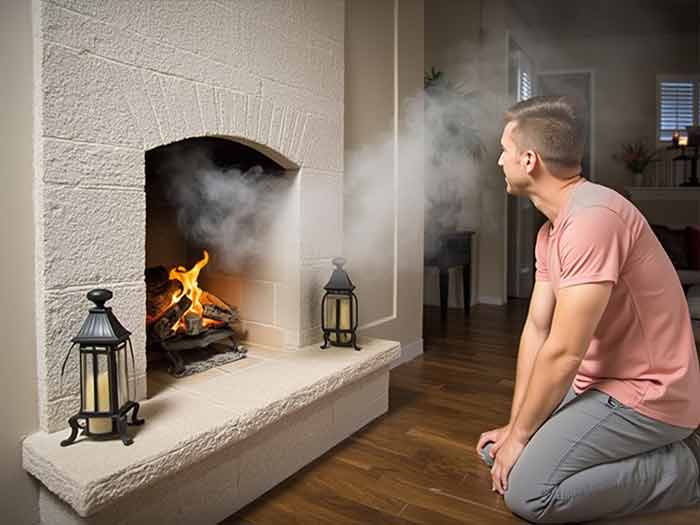
This one catches people with newer homes. Everything that moves air out pulls against the chimney: the range hood, bath fans, the dryer, a radon fan, even a leaky furnace return in a closed closet. A leaky old house lets replacement air seep in around windows. A well sealed house often finds its easiest opening at the chimney, so air flows backward down the flue and drags exhaust with it.
The symptom is intermittent, which is what makes it maddening. Everything drafts fine until someone runs the kitchen hood while the water heater is firing.
A chimney too short for its roof
Chimney height is not cosmetic. The rule of thumb is three feet above the roof penetration and two feet above anything within ten feet. A short chimney sits in turbulent air spilling over a ridge, and on a windy day that turbulence beats the draft. Steep pitches, a tall addition next to an old stack, and a ponderosa grown over the roofline all do it. Our guide to a smoky fireplace that will not draft covers the same physics.
Table 1. Venting faults, how they show up, and what corrects them
| Fault | How it shows up | Why CO risk rises | Correction |
|---|---|---|---|
| Blocked flue or stuck damper | Smoke rollout, soot on the face | Exhaust has nowhere but the room | Sweep, camera scan, damper repair |
| Animal nest at the top | Scratching, drafting change in spring | Plug at the termination | Removal, then a listed cap |
| Cracked or collapsed liner | Tile chips in the cleanout | Gas escapes into wall cavities | Joint repair or a new liner |
| Negative pressure indoors | Intermittent, worse with fans on | Flow reverses into the house | Combustion air, pressure testing |
| Chimney too short | Wind dependent smoke and odor | Downdraft beats a weak draft | Extend the flue, fix termination |
What spilled exhaust leaves behind near an appliance
Venting failures leave physical evidence. None of it proves there is carbon monoxide in the air right now, and none of it replaces an alarm, but each item says exhaust is not all going up the flue. This is the short list tied to spillage. For the broader set of symptoms that say a chimney needs attention, see the signs your chimney needs service.
- Soot or dark staining around an appliance. A smudge above a water heater draft hood, a black halo over a fireplace opening, or sooty streaks at a connector joint mean exhaust is escaping.
- Heavy condensation on windows. Water vapor is a combustion product. Windows fogging near the appliance while the rest of the house stays clear can mean exhaust moisture is staying indoors.
- Rust on vent pipes and connectors. Rust means condensation inside metal that should run warm and dry, usually because exhaust cools too fast in a cold or oversized flue.
- A pilot light that keeps going out. A pilot that will not stay lit, or drops when a fan kicks on, is often a draft problem rather than a bad thermocouple.
- A yellow, lazy flame or sooty gas logs. A healthy gas flame is crisp and mostly blue. Yellow tips and black soot point to poor combustion air.
How house evidence differs from symptoms people feel
The evidence above sits in the building and stays put. Symptoms sit in people, come and go, and mimic ordinary illness: headache, dizziness, nausea, weakness, confusion, a flu-like feeling without fever. Two patterns matter. Symptoms often ease outdoors and return indoors, and more than one person or pet may feel it at once. In Colorado that is easy to misread, since headache and fatigue are what visitors get from altitude anyway. We are chimney people, not medical people, and anyone who feels unwell should get fresh air and medical advice.
Table 2. Evidence in the building compared with symptoms in people
| Clue | Where it appears | What it suggests | Reliability |
|---|---|---|---|
| Soot staining at an appliance | Walls, draft hood, glass | Exhaust escaping or burning poorly | Good early signal |
| Rusting vent pipe | Mechanical room, basement | Condensation inside the vent | Good, but slow to appear |
| Condensation on nearby windows | Rooms next to the appliance | Combustion moisture indoors | Suggestive, other causes exist |
| Pilot outages, yellow flame | At the burner | Draft or combustion air problem | Strong hint, easily ignored |
| Headache, nausea, fatigue | Occupants and pets | Possible exposure, many causes | Unreliable and late |
| CO alarm activation | Anywhere in the home | Measured gas at the sensor | The only real measurement |
Where carbon monoxide alarms belong
Placement is where most households fall short. Layer the coverage so a problem starting anywhere reaches someone asleep.
- One on every level, including a finished basement and any finished attic space.
- One outside each separate sleeping area, close enough to wake someone through a closed door. Colorado writes its requirement as an alarm within fifteen feet of the entrance to each room used for sleeping.
- One on the level with fuel burning appliances, kept the distance the instructions call for from the appliance so startup does not cause nuisance alarms.
- Mounting height per the manufacturer. Carbon monoxide mixes with room air rather than pooling low or high.
- Skip the dead spots: stalled corners, above a stove, inside a bathroom or garage, in direct sun, or in front of a supply register.
- Test monthly and replace the alarm at the end of life date printed on the housing. Sensors wear out no matter how the battery is doing.
Colorado has required carbon monoxide alarms in dwellings with a fuel burning appliance, a fireplace, or an attached garage since 2009, and the obligation attaches at a sale, a new tenancy, or a permit pulled for interior work. Our summary of Colorado chimney laws and regulations covers where those rules meet chimney work, and alarm checks belong on the same list as the winter chimney safety checklist.
What to do when a CO alarm sounds
The advice here is deliberately boring and it does not bend to circumstances. Do not investigate first, do not open windows and wait, and do not assume the unit is faulty because nobody feels unwell.
- Get everyone out of the building, pets included, into fresh outdoor air, and count heads.
- Call 911 from outside. Fire crews carry meters and can tell you the actual level room by room.
- Stay out until the responding crew says the building is clear.
- Get medical attention for anyone with symptoms, and say that carbon monoxide is suspected.
- Leave the appliances off. Do not relight a pilot or reset a furnace to test the alarm.
- Have the venting inspected and the fault corrected before anything goes back into service.
One nuance worth learning in advance: a single periodic chirp usually means a low battery or an end of life notice, while a repeating pattern is the real thing. Read the label on your units now, not at two in the morning.
Gas appliances hide their venting problems
Wood burning gives you feedback. You see the smoke, you smell the fire, you look at the creosote the sweep pulls out. Gas gives you nothing. It burns clean, it runs quietly, and when its venting fails it fails silently, which is why a gas flue earns the same attention a wood flue gets. Scheduling is its own question, covered in how often to sweep a chimney in Colorado.
Several ordinary events change a venting system without anyone thinking about the chimney.
- A furnace is replaced with a high efficiency model venting out a sidewall, leaving a water heater alone on a flue built for two appliances.
- A kitchen remodel adds a much larger range hood, so the house can be depressurized far more than before.
- Air sealing, new windows, and insulation cut off the leakage that supplied replacement air.
- A gas log set drops into an old fireplace, or a damper clamp comes out and never goes back.
- Hail or wind takes out a cap, and the flue spends a season open to weather and wildlife.
None of those are mistakes. They are changes to one part of a system by people whose trade does not include the other part. If you are having gas equipment installed, our page on a gas insert in Colorado covers what the venting has to satisfy. Late summer, ahead of heating season, is the easy time to reach us at (720) 207-9232.
How a technician measures draft, spillage, and CO at the appliance
A CO focused visit is not a glance up the firebox with a flashlight. We follow the whole path from burner to termination.
- Appliance condition, flame character, and burner cleanliness.
- The connector: pitch, support, joints, corrosion, and seating at the thimble.
- A camera scan for blockage, cracked or missing tile, and gaps between flues.
- Liner type, and whether it suits the appliance connected to it now.
- Cap, crown, and termination height relative to the roof.
- A draft and spillage test with the house in its worst case, exhaust fans running.
- Carbon monoxide readings in the room and in the flue while the appliance runs.
How deep that goes depends on the situation. A routine annual check is a different job from what we do after a chimney fire, an appliance change, or an alarm activation, and our breakdown of the chimney inspection levels explains which fits which. Our numbers live on the pricing page rather than in an article.
Plenty of this is homeowner work, and our DIY chimney checkup covers what you can do yourself. What it cannot settle is whether a venting system is safe. A flashlight will not show a washed out mortar joint twenty feet up, and the worst backdrafting is intermittent, so a flue can test clean in the morning and spill badly that evening.
Frequently Asked Questions
Can a chimney give off carbon monoxide?
The chimney does not create it. The appliance does, and the chimney carries it outside. When a flue is blocked, cracked, or backdrafting, the carbon monoxide can enter the house instead of leaving over the roof. A chimney is not a source, but a failed one is a common pathway.
Does a wood burning fireplace produce carbon monoxide?
Yes. Any fuel that burns produces some, and a smoldering fire starved of air produces far more than a hot, well fed one. That is why an open fireplace needs a clear flue and replacement air in the room, and why closing a damper on glowing coals is a bad idea.
Where should I put a CO alarm if I have a fireplace?
Cover every level and every sleeping area first, then add one on the level with the fireplace, in the same room or adjacent. Keep it away from supply registers, drafts, and the peak of a vaulted ceiling, and follow the instructions that came with the unit.
My alarm sounded and then stopped. Do I still need to do anything?
Yes. An alarm that sounds and then clears means gas reached the sensor and later dispersed, which is information rather than a false alarm. Evacuate and call 911 while it is sounding, and have the venting inspected before the appliances go back on.
Do gas fireplaces and gas logs need a chimney inspection?
They do, and they are the ones most often skipped. Gas burns cleanly enough that homeowners assume there is nothing to maintain, but the vent can still be blocked, corroded, disconnected, or wrong for the appliance attached to it. Annual inspection is the standard recommendation.
How do I tell a carbon monoxide problem from a natural gas leak?
A natural gas leak is raw unburned fuel, and utilities add an odorant so it smells like rotten eggs. Carbon monoxide is a combustion product with no odor at all. The response overlaps: leave the building and call 911 from outside, and mention which one you suspect.
How often should the venting on my appliances be checked?
Once a year for any chimney or vent serving a fuel burning appliance, plus any time an appliance is added, removed, or replaced, and after a chimney fire, a hailstorm, or an alarm activation. The yearly sweep visit is the natural time for it.
Get your venting checked before you need it
If your CO alarms are older than you can remember, if a furnace or water heater has been swapped since anyone looked at the chimney, or if a fireplace has been smoking more than it used to, that is a straightforward visit. We will camera the flue, check the connector and the cap, test for spillage, and tell you what you are dealing with.
Call the shop at (720) 207-9232 or book a chimney inspection in Denver, and we will come out from Aurora to anywhere on the Front Range. If an alarm is sounding right now, put the phone down, get everyone outside, and call 911 first. We will still be here afterward.