If your gas fireplace pilot light will not stay lit, the cause is almost always one of two things: a thermocouple or thermopile that no longer makes enough voltage to hold the gas valve open, or a pilot orifice that is partly plugged. Between them they account for most of the no heat calls we run across the Denver metro once October turns cold.
Here is why. A standing pilot fireplace cannot feed gas to the burner unless a small sensor is being heated by a live pilot flame. That sensor makes its own electricity, and that trickle of millivolts is the only thing holding a safety magnet open inside the gas valve. Weaken the flame or the sensor and the valve shuts. The fireplace is not broken; it is doing what it was built to do.
Below is how the system works, what each symptom points to, the checks you can safely make yourself, and where this becomes licensed gas appliance work.
How a Standing Pilot Gas Fireplace Works
A standing pilot system runs with no house current, which is why your fireplace still works when a Front Range windstorm takes the power out. Heat at the pilot becomes a small current by way of two dissimilar metals joined at a tip, hot on one end and cool on the other. If the flame drifts off that tip, or the sensor ages, or a connection corrodes, the voltage sags and the valve loses its grip. No error code. The fireplace just goes quiet.
The Thermocouple and the Pilot Safety
The thermocouple is the thin rod, about the diameter of a pencil lead, with its tip in the pilot flame. Its only job is to prove the pilot is burning. When you press and hold the control knob during lighting, you are holding that safety magnet closed by hand while the rod warms up. A healthy one needs thirty to sixty seconds of steady flame contact before it holds on its own.
The Thermopile and the Main Burner
The thermopile, also called a powerpile, is the fatter sensor beside it: a stack of thermocouples in series, producing far more output. That output runs the wall switch, remote receiver, or thermostat circuit and opens the main burner valve. It is why a fireplace can hold a perfect pilot and still send no heat into the room: the thermopile has faded enough to hold the small circuit but not to lift the main valve.
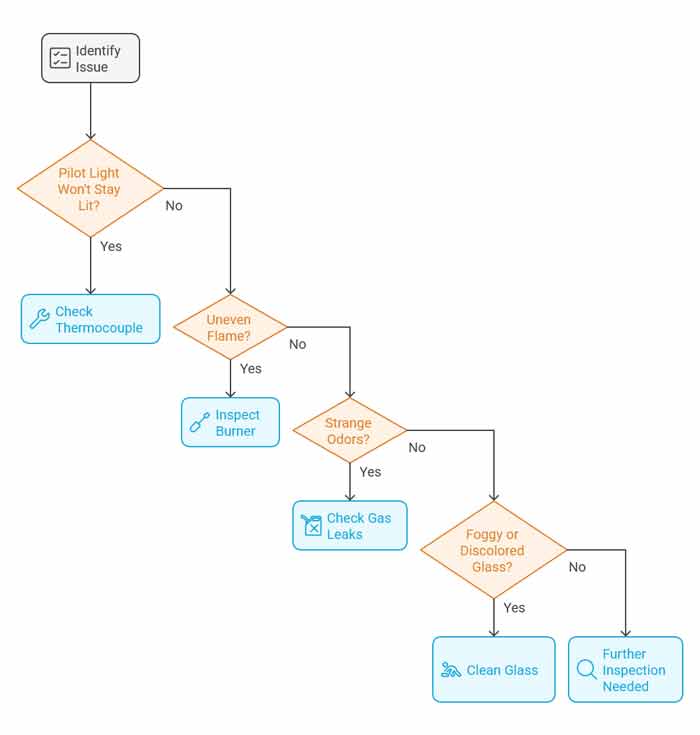
Symptom, Cause, and Fix: The Fast Diagnostic
Find your symptom below before touching anything.
Table 1. Gas fireplace pilot and ignition symptoms matched to the causes we find most often and who should handle them.
| Symptom | Most likely cause | What we check first | Who handles it |
|---|---|---|---|
| Pilot will not light at all | Gas off, air in the line, plugged orifice, no spark | Shutoff, spark quality, pilot hood | Start yourself |
| Pilot dies when you release the knob | Worn or dirty thermocouple, flame missing the tip | Flame shape, thermocouple output | Pro |
| Pilot holds, burner will not fire | Weak thermopile, failed switch, dead receiver batteries | Thermopile under load, switch continuity | Batteries yourself |
| Quits after five to twenty minutes | Blocked venting, spillage, thermopile fading hot | Termination cap, spillage test | Pro, stop using it |
| Weak, yellow, lazy or lifting pilot | Blocked orifice, spider web in the venturi, wrong altitude orifice | Orifice, manifold pressure, rating plate | Light cleaning yourself |
| Burner flames tall or sooty | Plugged burner ports, air shutter off, logs moved | Burner ports, log position, flame pattern | Log placement yourself |
| Clicks repeatedly, never lights | Electronic ignition with dead batteries, dirty sense rod | Battery pack, electrode gap, flame signal | Batteries yourself |
Working Through the Most Common Symptoms
The Pilot Will Not Light At All
Start with the boring possibilities. A shutoff handle crosswise to the pipe is closed, parallel is open, and we find plenty closed during a remodel and never reopened. Then look at the pilot hood. These fireplaces sit unused six months a year, and a pilot assembly is a warm, sheltered, perfectly sized cavity for a spider. We pull webs out of pilot hoods and burner venturi every September, and the orifice behind them is a hole smaller than a pin. A piezo igniter should snap a crisp blue spark on every press; a weak orange spark or none points at the electrode or its cracked insulator.
The Pilot Lights But Dies When You Release the Knob
This is the version we hear most, and it is nearly always the thermocouple or the flame meant to heat it. Look at the flame first. A healthy standing pilot:
- A firm blue cone with a small soft yellow tip, steady rather than wandering.
- Flame wrapping the top half inch of the sensor tip, not brushing past it.
- Roughly half an inch to an inch long, quiet rather than roaring.
- No lifting, where the flame separates from the hood and floats above it.
If the flame is small, yellow, or aimed past the sensor, cleaning the pilot assembly often brings it back. If the flame looks right and the unit still drops out, the thermocouple has aged out. They are consumable parts, and ten to fifteen years is a good run.
The Pilot Holds But the Main Burner Will Not Fire
Now we are on the thermopile circuit: a weak thermopile, a failed wall switch, corroded spade connectors at the valve, or dead batteries in the remote receiver, roughly in that order. That last one surprises people. Many units hide a receiver box behind the lower louver holding AA or AAA cells. Those batteries do not run the fireplace, they close the connection between thermopile and valve, and dead ones look exactly like a dead fireplace.
What the Millivolt Readings Mean
A meter turns guesswork into measurement, the difference between replacing the right part and replacing three. The ranges below are typical trade service values; your appliance service manual always wins over a general chart.
Table 2. Typical millivolt service ranges for standing pilot components, and the readings that tell us a part is finished.
| Component and test | Typical healthy reading | Marginal or failed | What it tells us |
|---|---|---|---|
| Thermocouple, open circuit, tip in flame | About 25 to 30 millivolts | Below roughly 15 millivolts | Cannot hold the pilot safety magnet |
| Thermopile, open circuit, no load | About 325 to 750 millivolts | Below roughly 300 millivolts | Aging generator, burner turns unreliable |
| Thermopile, under load with the switch on | Drops to about half the open reading | Below roughly 150 millivolts | Valve will not hold, explains an intermittent burner |
| Switch and wiring circuit | Near zero resistance when closed | Any measurable or unstable resistance | Corroded terminals stealing the voltage |
| Flame quality at the pilot | Blue cone engulfing the sensor tip | Yellow, short, lifting, or off the tip | Orifice or gas pressure, not the sensor |
Not Every Gas Fireplace Has a Standing Pilot
Identify what you have first, because the failure list changes completely. The rating plate and lighting instructions live behind the lower louver. Newer inserts and direct vent units often use electronic ignition instead of a summer long pilot flame, which saves gas but adds electronics that can fail.
Table 3. The three ignition systems we service on Front Range gas fireplaces and how their failures differ.
| System | How it lights | Power source | What we find failing |
|---|---|---|---|
| Standing pilot, millivolt | Pilot burns continuously, lit by hand or piezo | Self generating at the sensors | Dirty orifice, worn thermocouple, weak thermopile |
| Intermittent pilot ignition | Pilot sparks on demand when you call for heat | House current with battery backup, or batteries | Dead backup batteries, dirty sense rod, cracked electrode |
| Direct spark or electronic | No pilot, spark fires the main burner | House current through a control module | Module fault, electrode gap, lost flame rectification |
Weighing fuel types for a remodel? Our comparison of gas and wood burning fireplaces in Colorado covers the tradeoffs, and our page on gas fireplace installation and service explains what a correct install looks like.
Oxygen Depletion Sensors and Other Safeties That Trip
A unit that lights, runs five to twenty minutes, then shuts down is tripping a safety rather than failing to light. On vented appliances that usually means a blocked cap or bird nest, a collapsed liner, spillage from a Front Range downdraft, or a thermopile that reads fine cold and sags once hot.
Vent free models add an oxygen depletion sensor in the pilot assembly, which shuts the gas off if room oxygen drops below a set level by letting the pilot flame lift away from the thermocouple. Yours may be working as designed, or tripping early. Neither is a part to bypass or file down. What a vent free unit is allowed to do varies by city here, and our city by city breakdown of Colorado chimney laws and regulations is the place to check yours. Any repeat shutdown also deserves a same day alarm check.
What You Can Safely Do Yourself
Real work a homeowner can do, with the appliance off and cold. Stop where the list stops.
- Confirm the gas is on. The inline handle near the fireplace runs parallel with the pipe when open.
- Try the wall switch, remote, and thermostat, and replace batteries in the handset and the receiver box behind the lower louver.
- Read the lighting instructions on the plate inside the lower compartment. Every valve differs.
- Turn the knob to OFF and wait a full five minutes before any relight. This clears unburned gas and is not optional.
- Hold the knob at PILOT for a full sixty seconds. Most failed relights we hear about were held for fifteen.
- Compare the pilot flame to the healthy description above.
- Clean gently. Vacuum the burner area with a brush attachment, blow the pilot hood out with short bursts of canned air, wipe the sensor tips with a soft cloth. Never sand them, use a wire brush, or poke anything into the orifice.
- Set the logs exactly where the manual diagram shows. A log shifted into the flame path causes more sooting and nuisance shutdowns than anything else on this list.
- If two careful relights fail, stop. More attempts fix nothing and they do put unburned gas in the firebox.
Where It Becomes a Licensed Gas Appliance Job
The line is not difficulty. It is which failures can put combustion products into your living room. We take over at any of these:
- Removing, testing, or replacing a thermocouple, thermopile, gas valve, or igniter assembly.
- Anything needing a manometer or a gas pressure change.
- Drilling, reaming, or swapping a pilot or burner orifice, including altitude conversions.
- Opening the sealed glass on a direct vent unit, whose gasket must reseat correctly or the appliance will not vent right.
- Any venting, liner, or termination cap work.
- Any unit that shuts down repeatedly, soots the glass, or sets off a carbon monoxide alarm.
Our fireplace repair and installation crew handles these. Where the firebox itself is failing rather than the ignition, a gas insert often beats repeated repairs.
Altitude and Why Front Range Elevation Matters
Aurora sits near 5,400 feet, Denver a bit over a mile, and homes we service up the canyons run 7,000 feet and higher. Thinner air carries less oxygen to the flame, so an appliance set up for lower elevation runs rich here. Gas appliances carry an elevation range on the rating plate, commonly up to around 4,500 feet as shipped, and above that the manufacturer specifies a high altitude orifice or conversion kit.
Skip that step and the result looks exactly like a pilot problem: a soft yellow flame that cannot heat the sensor, soot on the glass and logs, a lifting burner, nuisance shutdowns. So before we condemn a thermocouple on a unit that never ran right, we read the rating plate. A fireplace with the wrong orifice eats sensors. The same thin air logic applies to the furnace and water heater sharing flue space in many older Denver homes, covered in our page on furnace and water heater chimney venting.
Gas Odor: The One Thing That Outranks a Relight
A faint whiff at the moment of lighting is normal. An odor that lingers, or that you notice with the fireplace off, stops the troubleshooting: leave the building without touching a switch or a phone, then call your gas utility emergency line or 911 from outside. The same rule applies to a sounding carbon monoxide alarm, and our guide to carbon monoxide and chimney safety in Colorado walks through that response and where alarms belong.
Why an Annual Service Visit Prevents Most of This
Nearly everything on this page is a maintenance problem wearing a repair problem's clothes. Webs, dust, drifting flames, corroded connections, and slow millivolt decline all announce themselves months ahead, to a tech with a meter in September rather than to a homeowner on the coldest night of the year.
A gas fireplace service visit is genuinely different from a wood chimney sweep. If you are unsure what your chimney needs, our explanation of chimney inspection levels sorts it out, and you can book a chimney inspection in Denver. This is how our techs work a pilot call:
- Verify gas supply, inlet pressure, and every shutoff in the line.
- Clean the pilot assembly, orifice, hood, and burner venturi.
- Measure thermocouple and thermopile output, open circuit and under load.
- Test the switch, thermostat, receiver, and every millivolt connection.
- Check burner ports, flame pattern, log placement, venting, and cap.
- Confirm the orifice and manifold pressure match the rating plate for our elevation, then test carbon monoxide in the room.
Frequently Asked Questions
Why does my gas fireplace pilot light go out when I release the knob?
Because the thermocouple is not making enough voltage to hold the safety magnet in the gas valve. Either the sensor has aged out or the pilot flame is too weak to heat it. Hold the knob a full sixty seconds first, since a short hold is a frequent cause of a failed relight. If it still drops, the pilot needs cleaning or the thermocouple needs replacing.
Can I clean the pilot on my gas fireplace myself?
Gentle cleaning is fine with the gas off and the unit cold: vacuum the burner area with a brush attachment, blow the pilot hood out with canned air, and wipe the sensor tips with a soft cloth. Never sand the tips or push anything into the orifice. Removing the assembly, testing pressure, or changing orifices is licensed gas appliance work.
My pilot is lit but the fireplace will not turn on. What is wrong?
That points at the thermopile circuit rather than the pilot safety. The likeliest causes in order are a weakened thermopile, a failed wall switch, corroded connections at the valve, and dead batteries in the remote receiver behind the lower louver. Check the batteries first, since that one costs nothing.
How long does a thermocouple or thermopile last?
Ten to fifteen years is a reasonable service life, and units in dusty basements or homes with pets sit at the short end. A thermopile usually declines gradually rather than failing outright, which is why a fireplace often turns unreliable for a season before it quits.
Does Colorado altitude really affect a gas fireplace?
Yes. Thinner air at Front Range elevations means less oxygen reaching the flame, so an appliance set up for lower elevation runs rich here. Many models are certified up to roughly 4,500 feet as shipped, and above that the manufacturer calls for a high altitude orifice or conversion kit. Skipping it produces lazy yellow flames, sooting, and repeat pilot failures that look like a bad sensor.
Should I leave my gas fireplace pilot light on all summer?
It is a judgment call. Leaving it lit keeps the firebox warm and dry, discourages spiders, and slows the corrosion idle assemblies pick up, but it burns gas for months you are not heating. Turning it off saves that gas at the cost of a harder relight in the fall.
How much does a gas fireplace pilot light repair cost?
It depends on what we find, since a cleaning and adjustment is a very different visit from a valve replacement on a discontinued model. Rather than quote a number that may not fit your appliance, we keep our current service structure on our chimney and fireplace pricing page, and we tell you the number before we start.
Get It Fixed Before the First Real Cold Snap
If your gas fireplace pilot light will not stay lit, work the safe checks first: gas valve position, batteries, a full sixty second hold, and a good look at the flame. Those settle plenty of calls with nobody coming out. If the pilot still drops, the burner will not fire, or the unit shuts itself down, that part is ours.
We are a family crew in Aurora servicing gas fireplaces, inserts, and hearth appliances across the Denver metro and Front Range. Call (720) 207-9232, or reach us through our contact page or check current rates on our chimney and fireplace pricing page, and tell us exactly what the fireplace is doing. The more specific the symptom, the better prepared we arrive.