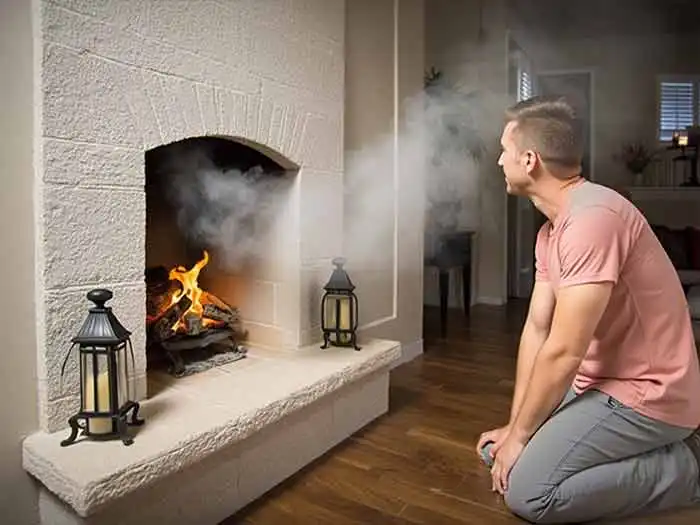
If your basement fireplace pushes smoke into the room while the one upstairs burns clean, the fireplace itself is usually not the problem. The house is. A basement firebox sits at the bottom of the pressure column inside your home, and in a two or three story Colorado house that column pulls hard in the wrong direction for most of the heating season. The flue has to beat that pull before it can carry a single wisp of smoke up and out.
The short version: warm air rises through the house and leaks out the top, replacement air gets drawn in at the bottom, and the easiest hole at the bottom is often the basement chimney. Add a long cold flue, thin air at a mile of elevation, a tightly finished basement, and a dryer running, and you have a fireplace that smokes on the first match.
This guide covers the below-grade special case only. For a main floor fireplace, start with our general guide to why a fireplace smokes and will not draft. Here we focus on what makes a basement different, how to test it, and the fixes in the order we would try them.
What the Stack Effect Does to a Basement Fireplace
Every heated house in winter behaves like a chimney of its own. Warm indoor air is lighter than the cold air outside, so it rises and escapes through every gap near the top: recessed lights, the attic hatch, the upstairs fireplace damper. Replacement air comes in low, through the rim joist, the dryer vent, and any open flue at the bottom of the house.
Somewhere in the middle of the house is a level where indoor and outdoor pressure match, the neutral pressure plane. Everything above it is slightly pressurized and leaking out. Everything below it is depressurized and pulling in. In a two story home over a basement, that plane often lands around the main floor, which makes the basement the room with the strongest inward pull in the building. When the house pulls harder than the flue pushes, air comes down the open chimney instead of going up it.
Why Colorado makes the fight harder
Draft comes from the density difference between hot flue gas and outdoor air, and at 5,000 to 7,000 feet the air is roughly 15 to 20 percent thinner than at sea level, so the same fire produces less push in the flue. The stack effect, though, scales with the temperature difference between inside and outside, and our winter nights hand you 60 to 70 degrees of it, so the house pulls as hard as it would at sea level while the flue pushes back with less. Front Range downslope wind adds suction on the east side of a house, which can tip a basement negative whenever the wind picks up. The altitude side of this is covered in depth in our guide to the chimney height rule in Colorado, so here we stay with what is specific to the basement.
Why the Living Room Fireplace Works and the Basement One Does Not
Same house, same chimney stack, same firewood, and only the basement fireplace smokes. The main floor firebox sits near or above the neutral plane, so it starts each fire with little house pressure against it. The basement firebox starts every fire with a headwind. Its flue is also the longer of the two, usually by 8 to 10 feet, which means more clay tile and brick to warm before the gas inside gets light enough to climb.
When both fireplaces share one chimney, the flues are neighbors. If the upstairs fireplace is drafting well, it pulls makeup air from the house, and the easiest source is often right down the adjacent basement flue. That is why some basement fireboxes smell of smoke when nobody has lit them in weeks. Our multi-flue chimney guide covers this crosstalk and the cap and height fixes for it.
The Usual Culprits, Side by Side
Basement smoke usually comes from a stack of small causes. Notice how many of them live nowhere near the fireplace.
Table 1. Common causes of basement fireplace smoke, how each presents, and a quick clue that points to it.
| Culprit | How it shows up | Quick clue |
|---|---|---|
| Negative pressure from upstairs leaks and exhaust | Worst on the coldest nights, smokes at startup and whenever the furnace or range hood kicks on | Cracking a basement window two inches clears it |
| Long cold flue | Heavy smoke for 10 to 15 minutes, then the fire settles and draws | A newspaper torch at the damper flips the airflow |
| Shared or adjacent flue pulling air down | Smoke smell when the upstairs fireplace or furnace runs, soot dust on an unused hearth | Smell without a fire |
| Oversized firebox opening | Smoke rolls out the top of the opening even with a hot fire | A board across the top few inches stops it |
| Tight finished basement | Smokes with the basement door closed, better with it open | Interior doors whistle or are hard to pull open |
| Dryer, bath fan, or range hood running | A sudden puff into the room when an appliance starts | Timing matches the appliance exactly |
| Radon fan drawing room air through slab gaps | Steady mild negative pressure, hard to pin down | Reversal eases when the fan is off for a test |
How to Test It with a Smoke Pencil or Incense Stick
A stick of incense or a smoke pencil, a cold evening, a helper, and twenty minutes will tell you most of it. Do this with a cold fireplace and no fire, so you are watching the house, not the flame.
- Pick a calm, cold evening. Close all exterior doors and windows and leave interior doors as you normally keep them.
- Open the damper fully and hold the lit incense just under it. Smoke that rises means the flue is drafting. Smoke that curls down into the room means the draft is reversed. Smoke that hangs and swirls means you are near neutral.
- Have your helper turn on the furnace blower, then the nearest bath fan, then the dryer, then the range hood, one at a time. Note which ones flip the smoke.
- Open a basement window two or three inches near the fireplace and check again. If the smoke now rises, the room is short on makeup air.
- Close that window and have your helper open, then close, a second floor window. If the reversal worsens, the stack effect is doing most of the work against you.
- If a second fireplace or the furnace shares the chimney, run it for ten minutes and test again. Smoke pulled down while the neighbor runs confirms crosstalk between flues.
- Hold a lit newspaper torch near the damper for a minute or two, then repeat the incense test. If the smoke now goes up, the cold flue is a major part of the picture.
- Write down what flipped it, along with outdoor temperature and wind.
Keep your carbon monoxide alarm active and never run the test with a live fire. If you smell furnace or water heater exhaust in the basement, stop and treat it as a carbon monoxide problem first.
The Fixes, in Order of Effort
We rank fixes by how much they cost you in time and disruption, starting with things you can do tonight. Most basement fireplaces need two or three of these together.
- Crack a basement window near the fireplace. Two or three inches gives the room its own makeup air.
- Close everything upstairs. Second floor windows, skylights, and the damper on any fireplace you are not using.
- Time the fire around exhaust appliances. Let the dryer finish and leave the range hood off until the flue is hot.
- Warm the flue first. A newspaper torch at the damper or a hair dryer aimed up the throat breaks the cold plug.
- Seal the upstairs leaks. Attic hatch, recessed lights, bath fan housings, whole house fan louvers. This lowers the neutral plane and takes pressure off the basement.
- Add an outside air kit. A ducted intake with its own damper gives the fire outdoor combustion air. An open fireplace still pulls some room air, but the kit cuts the cold draft across the floor and makes the other fixes work better. Our guide to stopping cold air from coming down the fireplace covers the same pressure picture running the other way.
- Correct or extend the flue. A cap must clear the roof by 3 feet and stand 2 feet above anything within 10 feet. Our guide to the chimney height rule in Colorado explains how to measure it.
- Reduce the opening. A smoke guard or fitted glass doors bring the opening back into proportion with the flue.
- Install a sealed insert. A direct vent gas insert or a lined wood insert changes the physics entirely.
Table 2. Basement fireplace fixes compared by effort, what each one addresses, and the trade-off to expect.
| Fix | Effort | What it solves | Trade-off |
|---|---|---|---|
| Crack a basement window | Minutes, no cost | Makeup air shortage | Cold draft on the floor, must remember every time |
| Pre-warm the flue | Minutes, no cost | Cold plug at startup | Does nothing for steady negative pressure |
| Seal upstairs air leaks | A weekend of DIY | Lowers the neutral plane, helps the whole house | Hard to find every leak without a blower door test |
| Outside air kit | Professional, half day | Combustion air competition | An open fireplace still pulls room air, so it reduces rather than removes the problem |
| Extend the flue | Professional, roof work | Short chimney, wind eddies, crosstalk | More cold mass to warm, visible from the street |
| Smoke guard or glass doors | Professional fitting or careful DIY | Oversized opening relative to flue area | Changes how the fire looks and how much heat reaches the room |
| Sealed insert | Professional, one to two days | Nearly all of the above, plus real heat output | Largest project, requires a liner and a permit |
Smoke guards, glass doors, and the opening ratio
A long standing rule of thumb in the trade is that the flue's cross section should be at least a tenth of the fireplace opening area. Many older Denver basement fireplaces miss that ratio, and altitude thins the margin further. A smoke guard is a metal strip, usually 4 to 8 inches tall, across the top of the opening. Glass doors do the same job and close the room off from the flue when the fire is out. Read our fireplace glass doors guide first, because the wrong size does more harm than good.
Why a Sealed Insert Is Often the Durable Answer Below Grade
Every fix above coaxes an open fireplace to work in a room that is fighting it. A sealed insert stops fighting. A direct vent gas insert uses a coaxial vent that pulls combustion air from outside through the outer pipe and exhausts through the inner one. Room pressure barely matters because the firebox is closed to the room, and it produces real heat instead of pulling warm air up the chimney. That is why we raise gas insert installation early in most basement conversations.
A wood insert reaches a similar result by a different route: a gasketed door, a small firebox, and a stainless liner, usually insulated, running the full height of the old flue. The liner has a fraction of the volume of the old clay flue, so it warms in a minute or two instead of fifteen, and an outside air connection can feed it directly. Our guide to wood burning stove inserts in Colorado compares the options.
An insert also turns a poor heater into the primary heat source for the lower level. We install both types and service existing units through our fireplace repair and installation service.
Radon Mitigation Systems and Your Basement Fireplace
Colorado has some of the highest radon potential in the country, and many Front Range basements have an active mitigation system: a pipe into a pit under the slab, a fan, and a discharge above the roof.
A properly installed sub-slab system pulls air from the gravel under the slab, not the room, and when the slab is sealed well its effect on room pressure is small. When it is not, the fan pulls room air down through slab cracks and the sump pit, adding to the negative pressure the fireplace is already fighting. If switching the fan off for a short test clears the smoke, have the radon contractor check slab sealing. Do not leave the fan off as a fix.
The reverse is also true. An open fireplace that depressurizes the basement pulls more soil gas up through the slab, so a smoky basement fireplace is a reason to test for radon. A sealed insert helps on both fronts because it stops using the basement as its air supply. After an insert goes in, retest.
Walkout Basements Versus Fully Below Grade
A walkout basement has one wall exposed to the outdoors with a door and windows. A fully below grade basement has none. The two behave differently at the hearth.
- Walkout: the exposed wall provides makeup air at floor level, which helps, but it is also where wind pressure acts. A walkout facing east, in the lee of a west wind, can go strongly negative on a windy night. The chimney is often on that exposed wall too, so the flue is colder and slower to warm.
- Fully below grade: no easy source of makeup air, the strongest stack effect pull in the house, and the coldest firebox. The one advantage is a chimney that usually runs through the center of the house, so once warm it holds draft well.
Walkouts respond well to the cheap fixes. Fully below grade fireplaces are where an outside air kit, an opening reduction, and eventually a sealed insert earn their keep.
When It Is Not a Pressure Problem at All
Everything above assumes the flue is clear and sound. Before you start sealing attic hatches, rule out the mechanical causes, because a basement chimney is the one homeowners look at least often.
- A damper that only opens partway, or a plate that has rusted and sagged into the throat.
- A bird nest, raccoon debris, or a fallen cap screen on the smoke shelf.
- A cracked liner or open mortar joint between two flues, letting one breathe into the other.
A chimney inspection with a camera run up the basement flue finds all of these in an hour, and a chimney sweep and cleaning takes care of buildup and debris. If the basement flue has not been looked at since you bought the house, start there.
Frequently Asked Questions
Why does my basement fireplace smoke only when it is very cold outside?
The stack effect grows with the temperature difference between inside and outside. On a single digit night the house pulls hard, the flue is colder, and the basement, at the bottom of the pressure column, loses until the fire is established.
Can I just open a basement window every time I light a fire?
Yes, and many people do. It gives the room its own makeup air. The downside is a cold draft along the floor. Treat it as the diagnostic that tells you an outside air kit or a sealed insert will work.
Will a taller chimney fix a basement fireplace that smokes?
Sometimes. If the cap is short relative to the roof or a nearby structure, an extension helps with wind turbulence and adds draft once the flue is hot. But a basement flue is already the longest in the house, and more length is more cold mass to warm at startup. Test for negative pressure first.
Does a radon fan make a basement fireplace smoke?
It can contribute when the slab is poorly sealed and the fan pulls room air instead of sub-slab air. A short test with the fan off will tell you. If it does contribute, the answer is better slab sealing, not leaving the fan off. Radon is the greater hazard.
Is a smoky basement fireplace dangerous, or just annoying?
Both. Smoke in the room means combustion gases including carbon monoxide are in the room, and a basement has less volume and fewer exits than a main floor. A reversed flue can also mean a furnace or water heater sharing the chimney is spilling. Keep a working carbon monoxide alarm on the lower level.
Do I need a gas insert, or can a wood insert work in a basement?
Either works. A direct vent gas insert is the most pressure proof option because it takes all of its air from outside through a sealed vent. A wood insert with an insulated liner, a tight door, and an outside air connection comes close. How you use the room and whether a gas line runs nearby usually decide it.
Next Step: Have the Basement Flue Looked At
Run the incense test on the next cold evening and write down what you see. If the fireplace clears with a cracked window, you already know the direction to go. If it does not, or if the basement flue has never had a camera run through it, book an inspection and we will sort the mechanical causes from the pressure causes in one visit. Call (720) 207-9232 and tell us it is the basement fireplace that smokes.