A multi flue chimney is one masonry stack carrying two or more separate passages inside it, each serving a different appliance. From the sidewalk it reads as one chimney. Inside it is two or three chimneys shoulder to shoulder, divided by thin masonry walls.
The rule underneath all of it is simple. Every solid fuel appliance gets its own flue, and that flue serves nothing else. A fireplace and a furnace do not share. When two appliances get tied into one passage, exhaust from whichever one is running takes the easiest way out, and sometimes that is the other appliance's room.
If your house went up in Denver before the 1970s, odds are good your chimney has more than one flue and nobody has told you which is which. Here is how to read your stack, and why an inspection that stops at the fireplace leaves half of it unchecked.
Why One Chimney Ends Up Carrying Two Or Three Flues
Older houses were built around a masonry core. A chimney cost money, so builders ran everything that needed venting up the same stack: the parlor fireplace, the coal furnace below, later the gas water heater that replaced it.
The combinations we run into most across the metro:
- A wood fireplace on the main floor plus a furnace flue from the basement.
- Two fireplaces stacked vertically, one in the living room and one above it.
- A fireplace flue plus a second flue carrying a gas furnace and water heater.
- A fireplace flue plus an abandoned coal flue that has vented nothing in fifty years.
Bungalows and four squares in Congress Park, Baker, Park Hill and the Highlands are full of these. Our guide to chimneys in historic Denver homes covers what else changes when the masonry is a century old.
One Appliance, One Flue, And The One Narrow Exception
NFPA 211, the Standard for Chimneys, Fireplaces, Vents, and Solid Fuel Burning Appliances, prohibits interconnecting a solid fuel appliance into a chimney that already serves another appliance. A flue gets sized, lined and terminated for one appliance burning one fuel. Add a second and every one of those numbers is wrong.
Solid Fuel Never Shares
A wood fireplace, wood stove, pellet stove or insert gets a dedicated flue, full stop. Two fireplaces on one flue is the classic version and the worst one. Whichever is lit takes the draft, and the cold one becomes a supply opening that delivers smoke into the other room.
The Narrow Exception For Gas
There is one place common venting is legitimate. A gas furnace and a gas water heater can share a flue sized for their combined input under the National Fuel Gas Code, so on a multi flue stack that pair counts as one flue rather than two. What goes wrong to that sizing later, and how the flue gets corrected, belongs to our guide on furnace and water heater chimney venting.
What A Shared Flue Costs You
Carbon monoxide has no color and no smell, and a breached or shared flue is one way it reaches living space instead of going up and out. Colorado law requires carbon monoxide alarms in single family homes that have a fuel fired appliance, a fireplace or an attached garage when the home is sold or transferred, and in rentals at a change of tenant. Our carbon monoxide and chimney safety guide covers placement.
Table 1. What each appliance needs from a flue of its own, and what we find when it shares.
| Appliance | Flue it needs | Sharing is | What we find on a shared flue |
|---|---|---|---|
| Wood fireplace | Dedicated, sized to the opening | Never allowed | Smoke in the other room, double creosote |
| Wood stove or insert | Dedicated liner, appliance to top | Never allowed | Stalled draft, creosote in an oversized void |
| Gas fireplace or log set | Dedicated flue sized to the appliance | Never with solid fuel | Soot and odor inside the appliance |
| Atmospheric gas furnace | Own flue, or a common vent sized to code | Only with another gas appliance | Oversized cold flue, condensation, spillage |
| Gas water heater | Same rule as the furnace | Only with another gas appliance | Orphaned on a big cold flue after a furnace swap |
The Wythe, The Masonry Wall Between Your Flues
The divider between two flues in one chimney is called a wythe. The residential code asks for at least four inches of solid masonry there, bonded into the chimney walls, and where clay liners sit against each other the joints have to be staggered by at least four inches as well. That divider is all that stands between furnace exhaust and the air your fireplace pulls.
It is also the most abused masonry on the chimney. Nobody looks at it, and in plenty of Denver stacks it was never a true four inches. What turns up on camera:
- Mortar joints washed out by water from a cracked crown, leaving loose brick.
- Heat damage from a chimney fire that cracked clean through into the next flue.
- A wythe built as a single brick on edge, or one that stops partway up.
- Liner joints that line up instead of staggering, giving smoke a straight path across.
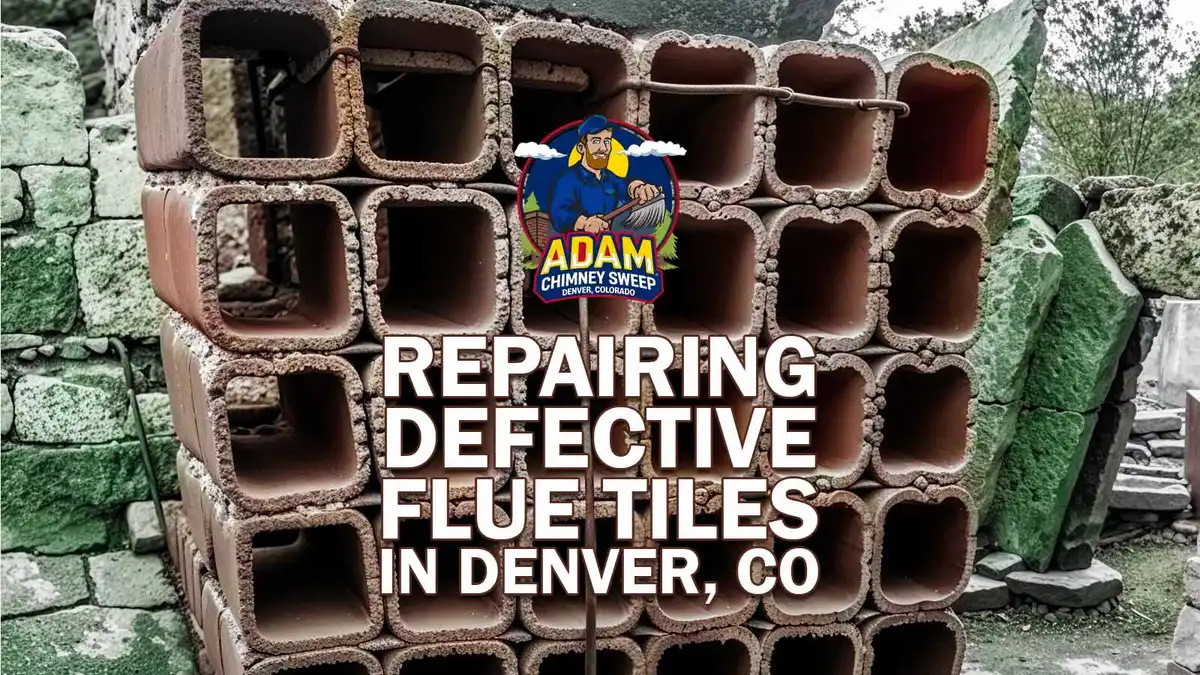
When the wythe fails, two flues stop being two flues. They become one shared passage with openings in two different rooms. Damage to the liner tiles themselves is a separate repair, covered in our guide to repairing defective flue tiles.
Cross Communication, Or Smoke In A Room With No Fire
Cross communication is the term for exhaust leaving one flue through a breach and entering the other. It produces the strangest calls we get, because the effect shows up nowhere near the cause.
- You light the living room fireplace and the basement fills with woodsmoke.
- The furnace kicks on and the family room smells like exhaust, damper closed.
- Soot builds up in a gas fireplace that never burned a stick of wood.
- A carbon monoxide alarm sounds in a room with no appliance near it.
- Warm air pours from an unused fireplace opening whenever the furnace runs.
- A campfire smell turns up in one room in July, which our guide on why a chimney smells covers.
House pressure decides the direction. A tight house with a big range hood, bath fans and a dryer running puts the lower floor under negative pressure, and the cold flue becomes the supply duct. That is why the symptom lands in the basement, and in winter.
How We Prove Cross Communication With Smoke And A Camera
Guessing at this is how people pay for the wrong repair.
- Set the house the way it behaves when the symptom appears. Windows closed, fans on, furnace running.
- Run a camera down each flue separately, recording the wythe face at every course.
- Seal one flue top and bottom, then push smoke into it under slight pressure.
- Watch every other flue opening, every cleanout, every thimble and every room served by the stack.
- Mark where smoke appears, how fast, and what height on the footage the breach lines up with.
- Repeat from the other flue, since a breach reads differently depending which side is pressurized.
Video plus smoke is what a Level 2 evaluation is for, and a Level 3 comes in when proving the breach means opening something up. Our explainer on chimney inspection levels covers when each applies, and you can book a camera chimney inspection in Denver.
Table 2. Multi flue symptoms, the likely cause inside the stack, and the test that settles it.
| What you notice | Likely cause | Test that settles it |
|---|---|---|
| Woodsmoke in a room with no fire | Breached wythe between two flues | Smoke test from the burning flue plus camera |
| Exhaust smell only when the furnace runs | Breach near the furnace connector | Smoke test with the furnace flue pressurized |
| Soot inside a gas fireplace | Wood exhaust crossing into the gas flue | Camera scan of both flues, mapping the soot |
| Cold air from an unused opening | Open abandoned flue acting as a supply | Pressure check with the exhaust fans running |
| Staining between two fireplaces | Failed crown directly over the wythe | Crown inspection from the roof, then a water test |
Counting The Flues In Your Own Chimney
You can get most of the way there from the ground with binoculars and ten minutes.
- Stand back far enough to see the whole top of the stack against the sky.
- Count the clay tiles or metal pipes above the crown. Each one is a flue, even if a single cap covers them all.
- Look at the width where the chimney leaves the roof. One flue is about the liner plus a course of brick each side. Wider means more.
- Count the appliances that need a chimney: fireplaces, stoves, an atmospheric furnace or boiler, a water heater vented into masonry.
- In the basement, find the cleanout door and any round metal thimbles where vents enter the brick.
- Look for a plastered over opening or a capped thimble. That is an abandoned flue, and it counts.
If the appliance count comes out higher than the flue count, stop and call somebody.
Caps On A Multi Flue Chimney, One Lid Or Several
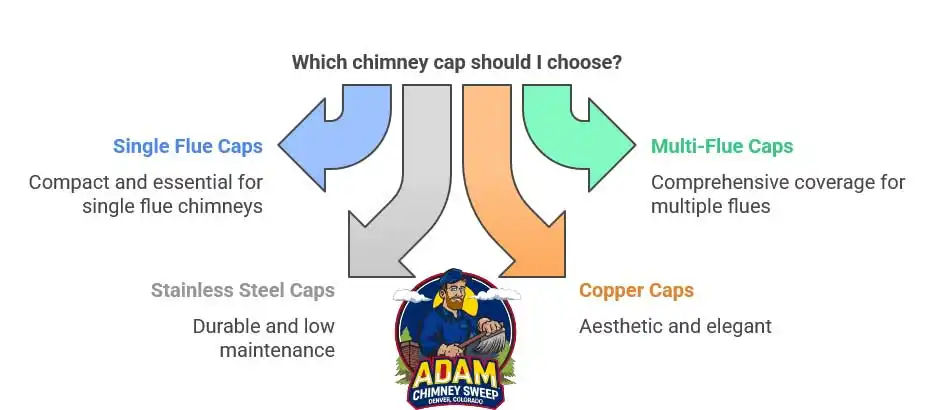
Every flue needs a cover. Rain, snowmelt, hail, wildfire embers and birds all go down an open flue, and on a multi flue stack an open flue beside a working one is also a shortcut waiting to be used.
Table 3. Individual flue caps compared with a single multi flue cap on a shared stack.
| Consideration | Individual flue caps | One multi flue cap |
|---|---|---|
| Crown protection | Crown stays exposed to weather | Whole crown shaded and shielded |
| Exhaust separation | Each flue vents to open air | Depends on lid height above the tiles |
| Front Range wind | More small parts exposed to gusts | Large lid needs heavy gauge and anchoring |
| Hail | Screens dent locally and stay usable | Light gauge lid deforms and ponds water |
| Best used when | Flues end at clearly different heights | Crown is weathering and needs full cover |
The failure mode with one big lid is height. If it sits close to the tops of the tiles, exhaust from a short flue goes sideways underneath, and the taller flue next door pulls it back down. The stack still has to satisfy the 3-2-10 rule, three feet above the roof at the high side and two feet above anything within ten feet. If your cap is missing or rusted through, we handle chimney cap repair and installation.
The Abandoned Flue Nobody Sealed
Almost every multi flue chimney we open in an older Denver house has a dead flue in it. What matters on a shared stack is not the dead flue itself but what it does to the live flue next to it.
- It takes water at the crown and delivers it into the middle of the masonry, so the wythe stays wet through every freeze thaw cycle.
- It is a preferred nesting site, and the debris holds moisture against that same divider.
- It feeds cold outside air into the house whenever an exhaust fan runs, dragging the working flue toward negative pressure.
- If the wythe beside it is broken, it becomes the exit path for the live flue.
Retiring one properly means a solid lid on top that still lets it breathe, the bottom closed with rated material rather than a rag, the old connector pulled, and the flue labeled. It still gets looked at every year. Putting a decommissioned flue back into service is a different decision, and we work through it in our guide to reopening an abandoned flue in an old Denver house.
Relining One Flue When It Has A Neighbor
Relining a single flue chimney is a clean job. Relining one flue inside a shared stack is a different animal, and it is worth knowing why before anybody quotes you.
- We inspect every flue in the stack, because the condition of the neighbor changes the plan.
- We evaluate the wythe. If it is breached, lining one flue and leaving the other bare puts a sealed passage beside an open one.
- We measure real internal dimensions at several heights. Shared stacks run out of plumb and carry offsets where flues jog around each other.
- We pick a liner and insulation that fit the space that exists, since insulation adds diameter.
- We keep the neighbor flue open and clean through the job so the other appliance stays safe to run.
- We rebuild the crown around both liners with overhang, drip edge and expansion joints, then re cap.
The recurring conversation is whether to line both at once. Often the honest answer is yes, because a second visit costs more than doing the work while the crew and the roof access are already there. Our chimney relining service page covers the liner types we use.
Why A Multi Flue Inspection Has To Cover Every Flue
Here is what we see most on a second opinion. The fireplace flue was swept, photographed and passed. Nobody opened the furnace flue, looked at the wythe, or counted the appliances against the tiles on top.
A chimney with three flues is three chimneys for inspection purposes, plus the walls between them. Every flue gets a camera. A report covering only the fireplace on a stack with two tiles above the crown is not finished. When the masonry needs work, our chimney repair crew in Denver handles the rebuild.
What Colorado Weather And Altitude Do To A Shared Stack
Draft is a pressure difference driven by temperature and stack height, and above five thousand feet there is less air to work with. Every appliance in the metro drafts with less margin, and that thin margin turns a small breach between two flues into a smell in the basement.
- Freeze thaw at the wythe. The top of the divider sits directly under the crown, thinner than any other masonry up there, and it soaks first when the crown cracks.
- Wind across a wide stack. Gusts create pressure differences between flue tops, so a short flue can go negative while its neighbor stays positive and pushes exhaust across.
- Several crown joints instead of one. A multi flue crown meets a tile at every flue, so late summer downpours have more seams to find.
- Wildfire embers. An uncapped abandoned flue is an open ember path into the framing around the chimney.
How the crown and the cap themselves wear in this climate is a topic of its own, covered in our guide on chimney cap versus chimney crown.
Frequently Asked Questions
Can two fireplaces share one flue if we never use them at the same time?
No. The problem is not simultaneous use. The moment one is lit, the other opening joins the air path, and smoke reaches it whether anything is burning there or not. Two fireplaces need two flues, and a stack with one flue means retiring a fireplace or rebuilding.
How do I tell which flue serves which appliance?
We map it during the inspection. A camera goes down one flue while somebody watches at the fireplace and at each thimble, or tracer smoke goes in and we watch which tile it leaves on the roof. Then the flues get labeled.
Is a cracked wythe repairable, or does the chimney have to come down?
Both outcomes are real, and it depends where the damage sits. Isolated breaches high in the stack can often be handled by lining the affected flues, which takes the wythe out of the safety path. Widespread damage low down means rebuilding from that point up.
My furnace and water heater share one flue. Does that count as one flue or two?
One. Common venting two gas appliances is allowed when the flue is sized for their combined input, so that pair occupies a single passage on your stack. Count it as one when you compare appliances against the tiles above the crown, and confirm the sizing still holds if either appliance has been replaced.
Does an abandoned flue still need to be swept?
It needs inspecting, and it usually needs cleaning once when it is retired. Old soot holds moisture, feeds corrosion and is still combustible if the wythe beside it ever lets heat through. After that, the annual job is inspection.
Can one cap safely cover three flues?
Yes, when it is built right. The lid has to stand well above the tallest tile so exhaust is not trapped underneath, it needs heavy gauge metal for Front Range wind, and the flues should end at different heights.
Will lining one flue fix a cross communication problem?
It fixes the direction it was tested in, and often that is enough, because a sealed liner means exhaust never reaches the breach. It does not repair the other flue, which can still take water, cold air and animals.
Ready To Map Every Flue In Your Chimney
A multi flue chimney is not a problem in itself. Most do their job for a century. What causes trouble is the part nobody checks: the wall between the passages, the flue left open after it was abandoned, and the appliance tied into a flue that already had a job.
Count the tiles on your stack, count the appliances in your house, and if the numbers do not match, get eyes on it before the first cold night. Call Adam Chimney Sweep at (720) 207-9232 to get on the schedule, or reach us through our contact page. We will show you footage of every passage in the stack, not just the one with the fireplace under it.