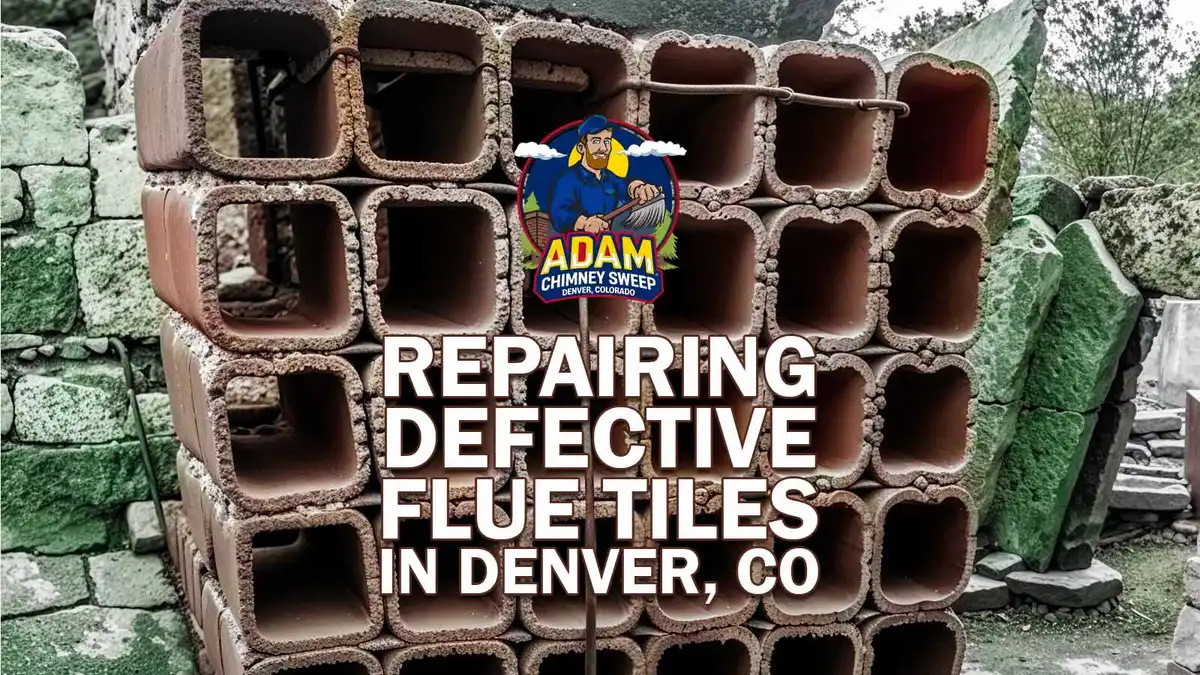
A chimney pot is a fired clay tube, usually terra cotta, that sits on the chimney crown and carries the flue a foot or two higher than the masonry. Its job is to add a little height, shape or narrow the outlet, and give smoke a cleaner exit into the wind. On a chimney that barely drafts, a pot can be the difference between a fireplace you enjoy and one that pushes smoke back into the room.
In Colorado, pots also fail in a particular way. Fired clay drinks water, freeze-thaw cycles pry it apart from the inside, hail chips the rim, and the mortar bed that holds the pot to the crown loosens a little more every winter. A cracked pot is a heavy piece of ceramic sitting where it can fall, and the gap at its base is one of the main ways water gets into a crown.
Our crew works on pots across Denver's older neighborhoods every season, and most of what goes wrong is predictable once you know what to look for.
What a Chimney Pot Is and Why Old Denver Homes Have Them
Chimney pots go back centuries in Britain and Europe, where coal fires in crowded rowhouses made draft a daily problem and a tall clay tube pulled better than a bare brick opening. The builders who put up Denver's brick homes between the 1890s and the 1930s brought the habit with them. You still see original pots in Capitol Hill, Congress Park, Park Hill, Washington Park, the Highlands, and the older blocks of Aurora.
Mechanically, a pot is an extension of the flue. The clay flue tiles stop at or just above the crown, and the pot sits centered over the last tile in a thick bed of mortar that British masons call flaunching. Most residential pots are 8 to 14 inches across at the base and 12 to 36 inches tall, in shapes from plain cylinders to tapered, louvered, or fluted patterns. Newer Front Range homes rarely have them; a modern chimney ends with the flue tile a couple of inches above a concrete crown and a stainless cap, which works when the chimney is tall enough and in clean air. Pots earn their keep on borderline chimneys and historic ones.
How a Pot Changes Draft Compared With a Plain Flue Tile
Draft comes from hot flue gas rising through a column of colder air, and Denver's thin air, roughly 18 percent less dense than at sea level, gives every foot of chimney a little less lift. The stack effect and altitude math are covered in our chimney height rule guide, so here we stick to what the pot itself changes.
A pot helps in three ways. It adds height, usually one to three feet, which lifts the outlet out of the turbulent air rolling off the roof ridge. A tapered pot narrows the opening, so the gas speeds up as it leaves, and moving gas is harder for a gust to push back down. And it raises the outlet above snow piled on the crown after a March storm.
What a pot cannot do is rescue a chimney that is too short for its location. It is not a code substitute for masonry that should have been built to the 3-2-10 rule. If your chimney is short, fix the height first; a pot on top of a short stack is a bandage.
When adding a pot solves a marginal chimney
We recommend a pot when the chimney is close to working and needs a nudge: it drafts fine on calm days and smokes only when wind comes over a taller roof, or it meets the height rule but sits below a big cottonwood that stirs the air. A pot will not fix a flue that is too big for the firebox, a cold exterior chimney, a tight house starved for makeup air, or a blockage, and on top of one of those it adds a restriction and makes things worse.
How Clay Chimney Pots Fail in Colorado
Terra cotta is porous. It soaks up two days of October rain, the temperature drops into the twenties that night, and the water inside freezes and levers off a paper-thin layer of the surface. Add June hail, wind rocking a loose pot, and the heat of the flue, and you have the list below.
Table 1. Common clay chimney pot failures in the Denver metro, what they look like from the ground, and what they put at risk.
| Failure | What you see | Why it happens here | What it risks |
|---|---|---|---|
| Frost spalling | Flaking or pitted surface, orange dust on the crown | Water in porous clay expands when it freezes, over and over | Pot thins, pieces drop onto the roof, base seal opens |
| Cracked or split pot | Vertical dark line, a step in the rim, or two halves leaning apart | Ice in a hairline crack, hail, or a hot fire on a frozen pot | Falling hazard, water pours into the crown |
| Loose in its mortar bed | Pot sits crooked, gap or missing mortar at the base | Bed cracked by freeze-thaw and by the pot moving with heat | Pot can tip and fall, water enters the crown |
| Pot too small for the flue | Sluggish draft, smoke at the lintel, heavy soot on the pot rim | Replacement chosen for looks, or an original sized for a coal grate | Chokes the fireplace, drives creosote, can spill carbon monoxide |
| Cap or screen that clogs | Tight mesh or bird guard packed with creosote, leaves, or snow | Small openings ice over in wet spring storms and glaze with creosote | Draft drops suddenly, smoke and carbon monoxide back up into the house |
| Water pooling at the base | Dark ring or moss around the pot, staining down the crown | Flat or dished crown, no drip edge, no sealant at the joint | Crown cracks, water tracks down between tiles and brick |
Why a Cracked Pot Is a Falling Hazard, Not Just an Eyesore
A residential clay pot typically weighs 20 to 80 pounds, and it sits on a bed of old mortar in the windiest air on the property, where Front Range downslope winds regularly gust past 50 miles per hour in the metro and much harder along the foothills. When a split pot lets go, the pieces slide down the roof and land on whatever is below: the walkway, a car, or a person. If you can see daylight through a crack, treat the pot as unstable until someone has been on the roof.
The crown suffers too. Every crack in the pot funnels water into the mortar bed. That water freezes, the bed heaves, and the crown cracks in lines radiating out from the pot. Water then runs down the outside of the flue tiles and shows up as efflorescence on the upper courses or rust on the damper. This is why a pot problem so often becomes a chimney crown repair by the time we are called.
Caps and Spark Arrestors for Round Pots
Every chimney in Colorado should have a cap, and pots are no exception. The complication is geometry. Standard caps fit square or rectangular flue tiles in common sizes, while a pot is round, often tapered, and frequently a size no catalog lists.
Table 2. Cap options for clay chimney pots, how each one mounts, and where each one falls short.
| Cap type | How it mounts | Best for | Watch out for |
|---|---|---|---|
| Clamp-on pot cap | A stainless band tightens around the outside of the rim | Sound pots with a true round rim in common diameters | Tapered or spalled rims slip; overtightening cracks old clay |
| Insert cap with legs | Three or four legs slide inside the pot and expand against the wall | Odd sizes and decorative pots you do not want to hide | Legs reduce the opening; a small pot gets even smaller |
| Top-mount cap over the pot | A large cap bolts to the crown or brick and covers the pot | Multi-flue chimneys, short pots, weathered rims | Hides the pot; needs a sound crown to anchor into |
| Custom fabricated shroud | Stainless or copper cut to the pot and chimney | Historic homes where nothing standard fits | Lead time and cost; outlet area must still equal the flue |
Whatever style you choose, the open area of the cap should be at least as large as the flue. Pots already narrow the outlet, so a cap that shrinks it again can tip a marginal chimney into smoking. Spark arrestor mesh matters here because of wildfire embers; the common half inch opening catches embers without icing shut in a wet April snow the way finer mesh does. Our chimney cap installation team carries templates for common pot sizes and fabricates for the odd ones.
Repair Versus Replacement, and the Modern Options
Not every damaged pot needs to come off. The decision comes down to whether the clay body is still sound and whether the problem is the pot or its bed.
When a repair is enough
- The pot is intact but rocking. We lift it, chip out the old bed, set it back in fresh mortar, and seal the joint. We call this rebedding.
- The rim has a few hail chips but no through cracks. Chips can be dressed and sealed and the pot capped.
The pot has to go when a crack runs its full height, when spalling has thinned the wall at the base, when it is too small for the flue, or when it is in pieces. Nobody should glue a broken pot back together on the roof.
Replacement options ranked for Colorado weather
Ranked from the material that handles freeze-thaw best to the one that needs the most care:
- Stainless steel pot style extender. A stainless sleeve that clamps to the top flue tile and extends it 12 to 36 inches. It cannot spall, weighs a fraction of clay, accepts standard caps, and can be painted to echo a pot. Our default for a plain chimney that needs height.
- Cast concrete pot. Molded from modern air-entrained concrete, these look traditional and handle freeze-thaw far better than old clay, but they are heavier, so the crown and bed must be solid.
- New fired clay pot. Denser than century-old clay but still porous, so it still needs a cap and a sealed base. The right answer when matching a historic streetscape.
Whichever you choose, half the job is the crown, which is why our chimney repair crew handles the pot, the crown, and the brick beneath them as one job.
The Crown Detail Around a Pot Matters More Than the Pot Itself
Old pots were set in a mound of brick mortar with no bond break and no sealant. That mound cracks in the first few winters, and from then on the pot is a decoration sitting over a leak. A proper modern detail slopes the crown away from the pot, with a drip edge so water falls clear of the brick face. The pot sits on a mortar bed, but the joint where clay meets crown gets a flexible sealant rated for masonry and heat, applied over a bond breaker so it can stretch as the pot moves. The bed is tooled to shed water, never left flat.
That flexible joint is the whole game, because the pot heats and cools faster than the crown and rigid mortar cannot follow. Asked whether to spend on a nicer pot or on the crown, we always say crown first: a plain pot on a sound, sealed crown will outlast a beautiful pot on a cracked one. Our chimney cap versus crown guide walks through the pieces.
Matching Pots on Historic Denver Homes
On a landmark or a house in a historic district, the pot is part of the roofline everyone sees, and an obviously new replacement can draw attention from the city's design review for designated properties. Photograph the existing pot before it comes down, measure its height and both diameters, and note any maker's stamp so a salvage yard or specialty maker can match it.
Two cautions. First, the mortar around a historic pot should be softer than the clay and the century-old brick below it, or the brick loses the fight. The reasons and the right mixes are in our historic home chimney guide. Second, an old pot often sits on upper courses that are themselves failing. Look at the brick just under the crown for the same flaking. That is spalling, and our spalling brick chimney repair guide explains how far it usually goes. The top few courses often need tuckpointing or a partial rebuild before a matched pot can be set safely. A new pot on spalled brick is a new hat on a wet cardboard box.
How to Inspect Your Own Chimney Pot From the Ground
You do not need to climb anything to catch most pot problems early. Grab binoculars or a phone with a decent zoom on a clear morning and run this list in late September and again in April after the freeze-thaw months.
- Find the spot where you can see the pot against the sky. Cracks show as dark vertical lines that do not match the pot's texture.
- Check that the pot stands plumb against a window frame. Any lean means the bed has failed.
- Look at the rim. Steps, notches, or missing chunks point to hail or spalling.
- Fresh orange or pink patches on a weathered pot are places where the skin just flaked off.
- Look at the base for a continuous, sloped mortar collar. Gaps, moss, or white staining down the crown mean water is getting in.
- Scan the roof and gutters for red clay chips or chunks of mortar, often the first sign.
- Check that you can see daylight through any cap or screen, then take a photo from the same spot each time.
Anything you cannot explain from the ground is a reason to book a chimney inspection.
After a hail storm
Hail treats a clay pot like a flower pot on your porch. After any storm that leaves stones bigger than a dime on the lawn, add these steps.
- Within a day or two, repeat the ground inspection and photograph the pot and crown so the date is in the photo data.
- Look for fresh chips with bright clay inside them and for any crack that was not in your earlier photos.
- If you file a roof claim, list the pot, cap, and crown as separate line items. Adjusters are used to shingles, not pots.
Our guide to chimney storm and hail damage insurance claims explains how to document the damage for a claim.
Frequently Asked Questions
Do I need a chimney pot at all?
No. Most Colorado chimneys work fine with a flue tile above a sound crown and a good cap. A pot is a tool for a chimney that drafts poorly, and an architectural feature on older homes.
Can I add a pot to a chimney that never had one?
Yes, as long as the crown is sound and the pot's inside area is at least as large as the flue. On a newer home a stainless extender is usually the better choice: lighter, no spalling, and it clamps directly to the flue tile.
Does a pot stop downdrafts?
It reduces them. Raising the outlet out of the roof turbulence and speeding up the exiting gas both make it harder for a gust to push smoke back down. It will not overcome a chimney that is far too short.
Can a chimney pot make draft worse?
Yes, if the pot is too small for the flue or fitted with a cap that shrinks the opening. The outlet should never be smaller than the flue it serves.
How long does a clay pot last in Colorado?
Original pots on Denver homes have often survived 90 to 120 years, but many are in their last decade. A capped new pot on a sealed crown can last decades; an uncapped pot on a flat crown may spall within a few winters.
Is a cracked chimney pot covered by homeowners insurance?
Sudden hail or wind damage is usually the kind of event policies cover; slow freeze-thaw deterioration usually is not. Document the pot before storm season so you can show what changed.
Have Us Look at Your Pot Before the Next Freeze
If your ground inspection turned up a lean, a crack, fresh clay on the shingles, or a stained crown, the cheapest time to deal with it is now, before ice does another season of work. We will check the pot, bed, and crown, measure for a cap that fits, and tell you plainly whether the pot can be rebedded or needs to come down. Call Adam Chimney Sweep at (720) 207-9232 or book online for a visit anywhere in the Denver metro and Front Range.