Old house chimney repair in Denver is a different trade from patching a chimney built in 1998. The stack on a Capitol Hill four square or a Curtis Park Victorian was laid up in soft, locally fired brick, bedded in lime mortar, usually with no flue liner at all, and it has stood through roughly a hundred and twenty Colorado winters. It is almost always repairable. It just has to be repaired on its own terms.
The short version: the mortar must always be softer than the brick it joins. Match the original in type, color, sand, and joint profile. Solve water first. And keep sandblasting, pressure washing, hard portland patches, and film forming sealers off historic brick entirely.
Most failed old chimneys we take apart around Denver were not killed by age. They were killed decades ago by a well meant repair done with modern materials the original wall could not tolerate.
Soft brick, lime mortar, and unlined flues: the pre-1930s stack
Soft, locally made brick
Denver became a brick city early, and the brick came from clay pits along the Front Range. Firing was uneven. In one wall you find hard, dark brick on the outer face and soft, salmon colored brick behind it, off the cooler edges of the kiln. That outer face carries a fire skin, a denser surface formed in firing, and it is the only weather resistance a soft brick has. Once it is gone, the brick drinks water for the rest of its life. Our guide to understanding your chimney covers the standard parts; this page is about the period materials.
Lime mortar, and why it was the right call
Mortar from this era is lime and sand, and it is deliberately weak. Weak mortar lets the wall move seasonally without cracking brick, lets vapor leave through the joint rather than the brick face, and erodes as a sacrificial layer while the brick survives. A mason in 1902 expected the joints to need attention eventually. That was the design, not a defect.
Unlined flues, and tile that arrived later
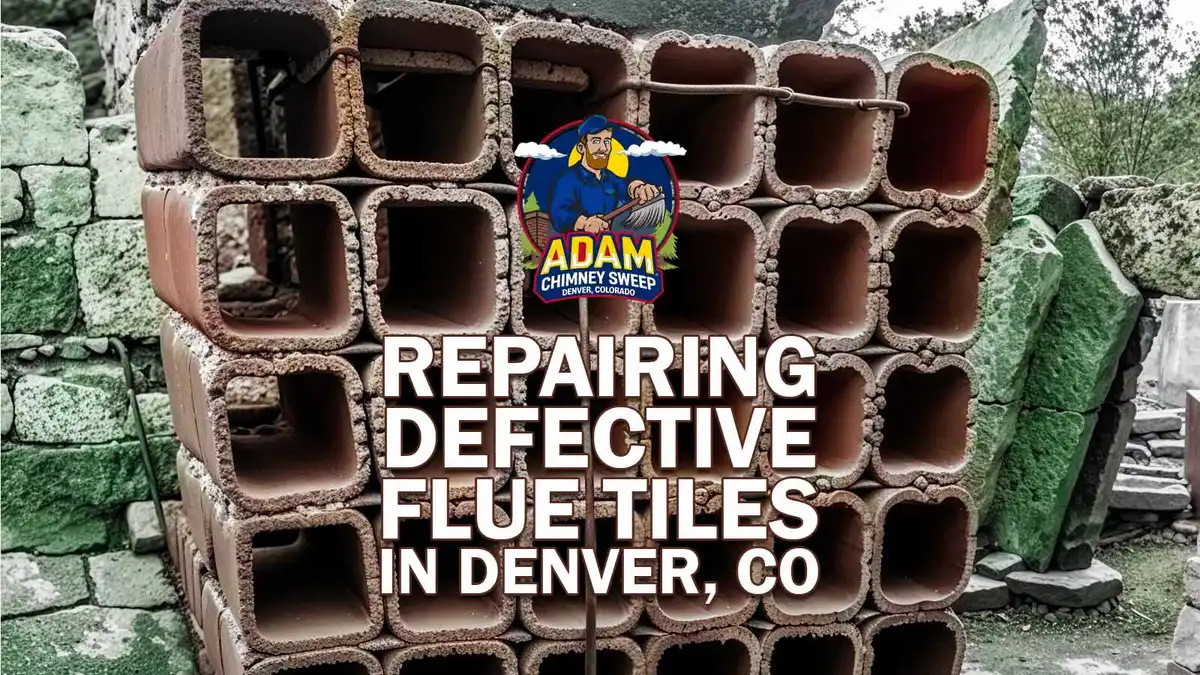
Most Denver chimneys built before the 1920s have no clay liner. The flue is a shaft through the brickwork, sometimes parged with lime, often not. Built for coal, then converted or left for wood, those joints have been eroding since the first fire. Some stacks got tile in a later remodel with corners cut: air gaps, no mortar between tiles, tile stopping short of the smoke chamber. Plenty of the lined old chimneys we scan turn out to be lined in name only, and our guide to repairing defective flue tiles in Denver covers cracked and offset tile.
The most damaging mistake: hard mortar on soft brick
If you take one idea from this page, make it this one. Mortar must always be softer than the brick it joins. Not equal to it. Softer.
Water gets into every masonry wall and has to leave. In a wall built with lime mortar it migrates out through the joints, the most permeable path. Freeze it there and the joint takes the damage, which is fine, because a joint is renewable.
Repoint that wall with hard portland and the joint becomes the least permeable path. Water leaves through the brick instead, arrives under the fire skin, freezes on a January night, and pops the face off. On the Front Range, where a south facing wall thaws at midday and refreezes after dark, that cycle runs over and over in one winter. The result is unmistakable: joints standing proud like a waffle grid, brick faces dished and salmon pink. The brick is being sacrificed to protect the mortar.
Table 1. Standard mortar types by strength, and where each belongs on a Denver house.
| Mortar type | Approximate published minimum strength | Where it belongs | Effect on soft historic brick |
|---|---|---|---|
| Type M | Around 2,500 psi | Below grade, foundations | Destructive. Spalls faces within a few winters |
| Type S | Around 1,800 psi | Modern structural masonry | Far too hard for pre-1930s brick |
| Type N | Around 750 psi | Modern veneer above grade | The common wrong answer, and still too hard |
| Type O | Around 350 psi | Interior, some later historic work | Sometimes right on harder 1910s brick |
| Type K and lime rich mixes | Around 75 psi and below | Soft handmade brick | Usually correct for Denver's oldest stacks |
The point of that table is scale. Type N, which most crews reach for without thinking, can be ten times stronger than the mortar it replaces. On a 1900 Baker cottage that is slow demolition. When we quote brick tuckpointing in Denver, matching the existing mortar comes first.
Matching mortar type, color, and joint profile
A correct repoint is three matches, and skipping one shows from the sidewalk. You match the existing mortar rather than a spec sheet, reading the old mix by hand for sand grading, lime lumps, and coal.
Color is mostly sand color, not pigment. Front Range sand runs warm and slightly pink, which is why a bag mix from elsewhere reads gray against a Denver wall even when the strength is right. A new joint should disappear at ten feet.
Joint profile controls where water sits and where it runs.
- Struck and weathered joints slope outward at the bottom so water sheds off.
- Concave joints tool tightly and shed wind driven rain on west and north faces.
- Grapevine and beaded joints appear on older decorative work and are worth reproducing.
- Overfilled, smeared joints mark a rushed job and trap water against the brick.
Here is how a correct repoint on a historic Denver chimney goes:
- Sample and read the existing mortar and brick, comparing an exposed elevation against a sheltered one.
- Cut failed joints out by hand, deep enough to reach sound mortar. Angle grinders take the brick arrises with them.
- Flush and dampen the joints, because dry old brick pulls water out of fresh mortar and leaves it dusty.
- Lay a test panel somewhere inconspicuous. Wet mortar is not the color of cured mortar.
- Pack the joints in lifts, then tool to the original profile when the mortar goes thumbprint firm.
- Keep it damp and shaded while it cures.
That last step is where Colorado punishes people. High altitude sun, single digit humidity, and an afternoon wind will flash dry a lime joint and leave it powdery.
What to do about an unlined flue
An unlined flue in a house you are burning in goes to the front of the list. Heat and combustion gases pass through eroded joints into wall framing, and on a shared rowhouse wall into the space next door. The right answer depends on the chimney.
Table 2. Options for an unlined or failed flue in a historic Denver home.
| Option | How it works | Good fit when | Tradeoffs |
|---|---|---|---|
| Stainless steel liner | Stainless run full height and insulated | The flue is straight and large enough | Sized to one appliance. May not fit a narrow coal flue |
| Cast in place liner | A form is set and cementitious mix pumped around it, curing seamless and bonded to the masonry | The flue is offset, irregular, or needs structural help | Longer job, reduces flue area, not reversible |
| Replace clay tile | Damaged tiles removed and replaced by opening the stack | A short accessible run, or a stack already apart | Invasive. Often means rebuilding brickwork |
| Seal and abandon | Flue cleaned, capped, sealed at the thimble | Nothing vents into it and nothing is planned | Removes the option later without reopening work |
| Direct vent gas insert | A sealed appliance vents up the old flue | You want heat and low maintenance, not an open fire | Changes the look and use of the firebox |
In a house with original narrow coal flues, stainless often will not fit at the size the appliance needs, and cast in place becomes the practical answer. Our guide on the cheapest way to reline a chimney covers where people try to save, and the service side sits on our chimney lining in Denver page.
Abandoned flues, and what happens when someone reopens one
An 1890s Denver house may have had five or six flues: parlor stove, kitchen range, bedroom stove, gravity furnace, water heater. Most were plastered over or hidden behind a thimble cover generations ago, until a remodel opens the wall, exposes a brick arch, and somebody thinks about lighting a fire. Here is what we find when we scan one:
- Joints eroded clean through inside the flue, opening into stud bays and lath cavities.
- Framing set into the chimney, normal practice then and a genuine hazard now.
- Coal soot, which is acidic and pulls moisture from the air. It is why old chimney breasts stain through fresh paint, and it keeps eating mortar.
- Flues that never ran full height, because the stove they served is long gone.
None of that means a decommissioned flue cannot come back. It means a camera goes down first, and the answer is a full liner or keeping it decorative.
One stack, several flues, and smoke in the wrong room
Denver rowhouses, Victorians, and many bungalows run several flues up a single stack, separated by a thin brick divider called a wythe. Modern practice keeps that divider solid and staggers the flue heights so they do not pull from each other. In a hundred year old stack the wythe is usually first to go, because it is the thinnest masonry in the chimney and gets cooked from both sides:
- Furnace or water heater exhaust turning up in an unused fireplace across the house.
- Wood smoke in a bedroom that has no fireplace, only a capped thimble.
- In a duplex or rowhouse, one unit smelling the neighbor's fire.
- A fireplace that drafts fine alone and smokes the moment the furnace kicks on.
Cross communication is invisible from the ground and the roof. It takes a camera in both flues and often a smoke test, which is what a Level 2 inspection is built for, as our page on chimney inspection levels explained lays out.
Draft is a separate problem with its own causes, and altitude sharpens all of them. If the fireplace smokes instead of crossing over, start with our guide to a smoky fireplace that will not draft.
Why sandblasting and pressure washing ruin historic brick
This is the other irreversible mistake, and it is usually a cosmetic decision, which makes it worse. Blasting removes the fire skin, and no coating puts it back. The brick drinks water from that day forward and spalls faster. Denver has whole blocks where you can pick out the house blasted in the 1970s: pitted faces, intact neighbors. High pressure washing does the same more slowly while eroding lime joints in seconds.
Table 3. Cleaning methods for historic Denver brick, by what they do to the brick face.
| Method | What it does to the brick | Verdict on pre-1930s brick |
|---|---|---|
| Dry sand or media blasting | Strips the fire skin, opens the pores permanently | Never. It cannot be reversed |
| High pressure washing | Erodes lime joints, saturates the wall, abrades the face | Never on soft brick |
| Low pressure water, soft bristle brush | Lifts surface soil without touching the skin | The correct starting point |
| Film forming sealers and elastomeric paint | Traps moisture and forces it out through the brick | Avoid. These accelerate spalling |
| Leaving the patina alone | Nothing | Often the right answer on a sound stack |
That sealer line matters, because homeowners buy those products to protect an old chimney. On masonry designed to breathe, a film forming sealer is hard mortar's mistake applied to the whole face at once.
Chimney work in a Denver historic district
If your house sits in a locally designated historic district or is an individually designated landmark, masonry work on a visible chimney can require approval before it starts. Curtis Park, Baker, and several districts around Capitol Hill carry local designation.
- Check designation first. Living in an old neighborhood is not the same as sitting in a designated district, and the boundaries do not follow what people call the neighborhood.
- Like for like repair is the easier case. Repointing that matches original mortar and profile is simpler than changing a chimney's height or adding visible metalwork on a street facing wall.
- Build approval into the schedule. Confirm current requirements with Denver Landmark Preservation before you order materials or lock a start date.
State rules and mechanical code apply on top of any local process, and our overview of chimney laws and regulations in Colorado covers that side.
What Colorado weather does to a 120 year old stack
Freeze and thaw. The cycle described above, running all winter: it is the largest destroyer of historic masonry on the Front Range.
Storm water and hail. Late summer downpours and the hail corridor go after the crown, cap, and flashing, and on an old stack that water runs straight down an open flue. We cover that ground in why your chimney is leaking and chimney cap vs crown.
How to prioritize when the budget is finite
Nobody restores a century old chimney in one season. There is a correct order, the same on every old house, and following it means each dollar protects the dollars behind it.
- Stop the water. Crown, cap, flashing, and the top few courses of brick. Everything below this line fails early if water is still getting in.
- Make it safe to use. Liner condition, the wythe between flues, clearances to framing, the smoke chamber.
- Repair structure. Repointing with correct mortar, resetting displaced brick, rebuilding a separated section, and the firebox. Our chimney repair in Denver page covers this work.
- Restore appearance. Secondary elevations, salvaged brick for spalled units, gentle cleaning.
- Improve performance. Draft work, dampers, and inserts, once the chimney underneath is sound.
The common way old house owners waste money is inverting this list, spending on the visible face while the crown is cracked and the cap is missing. Two winters later the pretty work is coming apart from behind. For what this work runs, see our chimney and fireplace pricing page.
Frequently Asked Questions
How do I tell whether my chimney has hard portland mortar in it?
Scratch a joint with a key. Lime mortar gives up powder easily, and portland resists entirely. Then read the damage. Joints standing proud with dished, pink brick faces is the signature of mortar harder than the brick. Bagged mix also reads grayer than the original.
Can hard mortar be removed once it is in there?
Sometimes, carefully, by hand, and it is slow. Portland can bond strongly enough that cutting it out takes brick with it, so on badly eroded faces the better answer may be to stabilize what is there. The first priority is making sure no more goes in.
Is an unlined chimney safe to use if it looks fine?
Looking fine from the firebox tells you almost nothing, because the deterioration is thirty feet up in a shaft you cannot see. Unlined flues here regularly have joints eroded clear through into framing cavities. Scan it with a camera. Then the choice is lining it or not using it.
My fireplace was bricked up years ago. Can I open it back up?
Often yes, but the flue decides. Get a camera down it to check for eroded joints, framing set into the masonry, coal soot, blockages, and whether the flue runs full height. Expect a liner in the plan. Lighting a fire in an uninspected flue is how old houses burn inside the walls.
Why does furnace exhaust end up in an unused fireplace?
Almost always a failed wythe, the thin brick divider between two flues sharing one stack. Once it opens, the flues pull from each other and exhaust crosses over. In rowhouses it can cross between units. Confirming it takes a camera in both flues.
Can I pressure wash soot or paint off my old brick chimney?
No. High pressure erodes lime joints in seconds and soaks a wall that cannot dry, and blasting strips the fired skin permanently. Start with low pressure water and a soft natural bristle brush, and test any chemical cleaner on a small hidden area first. Often the right answer is to leave the patina alone.
Do I need city approval to repair a chimney on a historic home?
It depends on whether the property is individually designated or sits inside a locally designated district, and on how visible the work is. Like for like repointing is a simpler case than changing the chimney's height or adding visible metal. Confirm your status with Denver Landmark Preservation first.
Is it ever right to take an old chimney down instead of repairing it?
Occasionally. If a stack is structurally unsound, serves nothing, and is not a character defining feature, removal below the roofline with a proper structural and roof detail can be the honest answer. More often it is repairable, and the estimate that said otherwise came from someone who knew one method.
Get a straight read on your old chimney before winter
Century old Denver chimneys are worth keeping. They were built by people who expected the joints to be maintained. What they cannot survive is modern material applied without understanding the original.
If you own a pre-1930s home with crumbling brick faces, gray patched joints, or a flue nobody has looked into since the coal came out, get eyes on it before freeze and thaw season. We read the masonry, camera every flue, and put findings in writing in priority order. Book a chimney inspection in Denver, call (720) 207-9232, or reach us through the contact page.