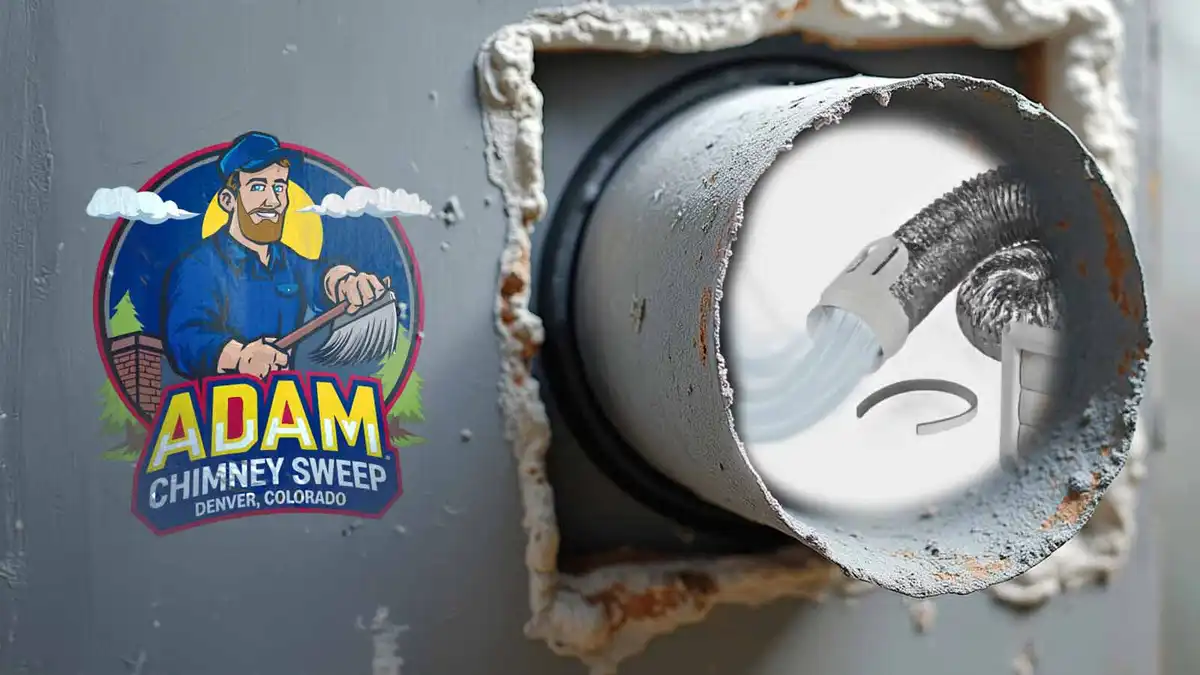
If your dryer used to finish a load of towels in one cycle and now needs two, look at the vent before you blame the machine. A clogged duct is one of the most common problems we find in Denver metro laundry rooms, and it never announces itself. It creeps. Cycles get longer, the room gets warmer, and one day the dryer quits partway through a load.
The signs your dryer vent needs cleaning are clothes that take more than one cycle, a dryer and a laundry room that run unusually hot, a burning or musty smell, an exterior hood whose flap barely opens, lint around that hood or behind the machine, a dryer that shuts itself off mid cycle on thermal overload, more than a year since the last cleaning, and any sign a bird or rodent has moved into the termination. One is worth acting on. Two or more means the duct is restricted enough to cost you money and shorten the life of the appliance.
How Air Is Supposed to Move Through a Dryer Duct
A dryer is a heater and a fan wrapped around a turning drum. The fan pulls room air across the element or gas burner, pushes it through the tumbling clothes where it picks up water vapor and loose fiber, then blows that hot wet air out a four inch duct to a hood on the outside wall. The lint screen catches the coarse fiber and never catches the fine stuff.
That fine fiber coats the duct. In a short straight rigid run, air moves fast enough to scour the walls. Wherever it slows, at an elbow, at a sag, at a screw poking into the airstream, at the cold last few feet where moisture condenses, fiber drops out and sticks. The deposit narrows the pipe, the narrow pipe slows the air, and slower air drops more fiber. It feeds itself.
A healthy vent pushes warm air out hard enough to hold a sheet of tissue off the hood opening.
The Eight Signs Your Dryer Vent Needs Cleaning
These are the eight we ask about on the phone, roughly in the order homeowners notice them.
- Clothes need more than one cycle. Water leaves fabric only when moving air carries it away. With the duct restricted, the same humid air keeps circling through the drum and the sensor keeps asking for more time.
- The dryer and the laundry room get unusually hot. Heat the exhaust should carry outside stays in the cabinet and radiates into the room. If the top of the machine is uncomfortable to touch, heat is not leaving.
- A burning or musty smell. A hot dusty smell means lint scorching on the element or in the blower housing. A damp musty smell is the reverse: moist air that never left is condensing in the duct and pushing back through leaky joints.
- The hood flap does not open, or barely puffs. A damper should swing open while the dryer runs and fall shut when it stops. A flap that flutters or opens a quarter inch means the velocity behind it has collapsed.
- Visible lint at the hood or behind the machine. Fiber piling on the siding means air slows enough at the exit to drop its load. Fuzz behind the dryer means a joint is leaking humidity into a wall cavity.
- The dryer shuts itself off mid cycle. That is the high limit thermostat or the thermal fuse doing its job after the cabinet hit a temperature it is not allowed to reach. Replacing the fuse without clearing the duct buys a few weeks.
- More than a year since the last cleaning. Even a good rigid run accumulates. If you bought the house and nobody handed you a record, assume it has never been done.
- Rodent or bird evidence at the hood. Twigs, feathers, droppings on the siding, chirping in the wall in April, or a flap propped open. A dryer hood is warm, sheltered, and the right size for a house sparrow.
Why a Restricted Duct Runs Hotter and Longer
The heater does not know the duct is dirty: it puts out the same heat whether air is moving or not. Cut the volume of air through the cabinet and that heat rides on less air, so everything inside gets hotter, the drum, the belt, the bearings, the wiring, the control board. Then double the run time, and every hot hour doubles with it.
- Energy first. You pay for gas or electricity across a cycle that should have ended.
- Fabric next. Heat and tumbling time, not detergent, kill elastic and towel loops.
- Then the machine. Motors, belts, rollers, and fuses live shorter lives in a hot cabinet.
Duct Material and Routing Decide How Fast Lint Builds
Two identical dryers can be years apart on cleaning schedules purely because of what the duct is made of and where it runs. Smooth rigid metal with taped joints is the standard for a reason: nothing inside catches fiber. Ribbed flexible duct is the opposite, and every ridge is a shelf.
Front Range jurisdictions build to the International Residential Code, and its clothes dryer exhaust section calls for metal duct four inches nominal in diameter, smooth inside, with joints running in the direction of flow and no screws projecting into the airstream. Behind the machine it allows one listed transition duct, no longer than eight feet and never concealed in construction. Vinyl and plastic accordion duct meet none of that, so replace those first if you find them.
Table 1. How duct material and condition change the rate of lint buildup.
| Duct type or condition | Interior surface | How lint behaves | Time to a restriction |
|---|---|---|---|
| Rigid metal, short run, taped joints | Smooth, continuous | Stays airborne, mostly exits | 2 to 4 years |
| Rigid metal, long horizontal run with a sag | Smooth, low velocity | Settles in the low spot | 12 to 18 months |
| Rigid metal joined with screws | Screw tips in the airstream | Each screw grows a lint beard | 12 to 24 months |
| Flexible foil accordion, crushed | Deeply ribbed, sagging | Every ridge collects | 6 to 12 months |
Counting Elbows to Find the Duct Run's Real Length
Homeowners measure duct runs in feet. Air measures them in resistance, and a turn costs far more than a straight foot. The code allows 35 feet of exhaust duct between the transition duct and the outlet hood, and every fitting is charged against that number: 5 feet for each tight mitered 90 degree elbow and 2 feet 6 inches for each 45, unless the dryer manufacturer publishes its own figures.
Table 2. Equivalent duct length for common Denver metro laundry layouts.
| Layout | Actual duct | 90 degree bends | 45 degree bends | Equivalent length | Within allowance |
|---|---|---|---|---|---|
| Main floor laundry, exterior wall | 12 ft | 0 | 0 | 12 ft | Yes |
| Basement dryer to a rim joist | 22 ft | 2 | 1 | 34.5 ft | Barely |
| Basement dryer jogging around joists | 25 ft | 3 | 0 | 40 ft | No |
| Upstairs laundry to the roof | 28 ft | 3 | 2 | 48 ft | No |
A run over the allowance is not automatically unsafe, but it clogs on a much shorter clock.
Why Colorado Basement Runs Are the Worst Offenders
Across the Denver metro, laundry keeps ending up in the basement. In older Denver and Aurora homes it moved down when the coal room became a utility room. In newer builds it lands in a finished basement or interior closet. Either way the dryer sits in the middle of the footprint and the exhaust has to travel horizontally through joist bays to a rim joist and out through the foundation near grade.
That geometry costs you three ways. Long horizontal runs give lint time and gravity to settle, with none of the lift a vertical run gets. Joist bays force jogs, and every jog is another 5 feet of equivalent length. The termination sits low, where snow, mulch, window well debris, and nesting birds reach it.
Then the climate leans on it. Winter puts a cold duct against warm moist exhaust, so condensation forms in the last few feet and turns loose fluff into a packed wet mat no shop vacuum will pull. Front Range wind holds flaps shut and hail dents hoods closed. In older brick homes we sometimes find a dryer exhausting into an abandoned masonry flue, which is never acceptable. If your dryer shares a chimney with a furnace or water heater, our guide to furnace and water heater chimney venting explains the danger.
Why Dryer Lint Is Such Good Tinder
Dryer lint is short cotton and polyester fiber, bone dry, packed loose with air all around it, and enormous in surface area for its weight. That is the definition of tinder, and our low humidity keeps it drier here than almost anywhere.
The ignition sources are already in the box: a heating element, a burner flame, a motor pulling hard on a hot bearing. Lint gathers where it is hottest, in the blower housing and first elbow, and where it is coldest, by the hood. National Fire Protection Association research on home clothes dryer fires identifies failure to clean as the leading factor contributing to ignition. A fire that starts in a joist bay travels through concealed framing the way a chimney fire travels up a flue.
If you smell hot lint mid cycle, work in this order.
- Stop the cycle and cut power at the outlet or breaker. On a gas dryer, close the shutoff valve.
- If you see smoke or flame, leave the door closed, get everyone out, and call 911 from outside.
- With no fire showing, pull the machine out, disconnect the transition duct, and look for a packed mat at the first elbow.
- Do not run it again until the whole run is cleaned. Fire in a joist bay behaves the way fire in a flue does, and our guide to chimney fire causes and warning signs covers the evidence it leaves.
Gas Dryers Add a Carbon Monoxide Risk
An electric dryer with a blocked vent is a fire and appliance problem. A gas dryer adds a combustion problem, because it burns fuel inside the cabinet and sends the products of that combustion out the same duct as the moist air. Block the duct and a burner starved for air burns incompletely, and what it produces has nowhere to go but back into the room.
Laundry rooms make that worse. They are small, often closed, and in many Colorado homes they share a utility space with the furnace and water heater, so a starved room can pull those appliances into backdrafting too. Never join a dryer duct to another appliance vent, and never terminate one into a chimney, crawl space, or attic. For alarm placement, the symptoms to watch for, and what to do when an alarm sounds, use our guide to carbon monoxide and chimney safety in Colorado.
What a Homeowner Can Safely Do
There is real work you can do yourself, and it makes a difference. Here is the honest scope of it.
- Clear the lint screen every load, and wash it with dish soap and warm water a few times a year. Fabric softener leaves a film that blocks a screen that looks clean.
- Vacuum the lint screen housing with a narrow crevice tool.
- Unplug the dryer, or shut the gas valve, and walk it out far enough to reach behind. Vacuum the floor and wall, disconnect the transition duct, and vacuum the first accessible section.
- Inspect that transition duct while it is off. Replace foil accordion with a listed semi rigid piece, keep it short and straight, and do not let it kink when you push the machine back.
- Reconnect with clamps and foil tape, never sheet metal screws. Screw points inside a duct are lint magnets.
- Go outside with the dryer running and hold a hand at the hood. You want a strong steady push. Confirm the flap opens fully, then clear nesting material, mulch, and snow around it.
What not to do: no leaf blower, which packs the far end and pushes fiber into the wall cavity. No hose or pressure washer. No drill driven brush through flexible foil, which tears open inside a joist bay. The same restraint applies to the fireplace in our do it yourself chimney checkup.
Stop there and call us at (720) 207-9232 when any of these are true.
- The run is longer than eight to ten feet, or any part of it is concealed.
- There are elbows you cannot see or reach.
- There is a bird nest, rodent nesting material, or a crushed section.
- The dryer has already tripped a thermal fuse or high limit thermostat.
- It is a gas dryer and something in the laundry room has smelled wrong.
What Needs the Whole Run Brushed
Vacuuming what you can reach handles the first few feet and does nothing for the concealed duct in the joist bay, which is exactly where the packed mat forms. Clearing that takes a rotary brush driven through the full length of the run with the debris captured rather than pushed deeper into the wall. Our dryer vent cleaning service in Denver page covers how that visit runs and what it includes.
Realistic Cleaning Intervals by Household
There is no single correct interval, because duct length and load count drive everything. These are the ranges we work from after seeing what comes out of ducts in this market.
Table 3. Typical dryer vent cleaning intervals by household and duct run.
| Household | Loads per week | Short rigid run | Long or elbowed run |
|---|---|---|---|
| One or two adults | 2 to 3 | Every 2 to 3 years | Every 12 to 18 months |
| Family of three or four | 5 to 7 | Every 18 to 24 months | Every 12 months |
| Family of five or more | 8 or more | Every 12 months | Every 9 to 12 months |
| Shedding pets, athletes, heavy towels | 10 or more | Every 12 months | Every 6 to 9 months |
| New home, no service history | Any | Now, then reset the clock | Now, then reset the clock |
Frequently Asked Questions
Is the problem the vent or the dryer itself
Disconnect the transition duct, pull the machine out, and run a load for ten minutes somewhere you do not mind getting humid. If the clothes suddenly dry at a normal rate, the duct is the restriction. If they still dry slowly, call an appliance technician.
How often should a dryer vent be cleaned in Colorado
Once a year is the safe default for most Front Range households. Every two to three years is reasonable only for a short straight rigid run in a one or two person home. Long basement runs, heavy volume, and shedding pets pull it shorter.
Can I blow the duct out with a leaf blower or vacuum it from outside
No. A leaf blower packs the far end into a denser plug and can force fiber into a wall cavity. A shop vacuum from outside pulls only the last foot or two, since suction dies quickly in a long four inch duct. A rotating brush is what removes the mat.
Is flexible foil duct really worse than rigid metal
Yes, and the difference is not subtle. Every ridge in an accordion duct is a ledge fiber catches on, and the duct sags between supports, creating low spots that hold lint and condensation.
My laundry is upstairs and vents through the roof. Is that different
The vertical rise helps carry lint along, but those runs are usually long and elbow heavy, and the cap is one you will never inspect from the ground. Roof terminated runs almost always need professional cleaning, because access is the whole problem.
Do you have to open my walls to clean the duct
Almost never. Rods and brushes reach through the run from the machine end, the exterior hood, or both, which is why we ask about the layout first. Opening a wall only comes up when a duct is crushed or disconnected inside the cavity.
Should I screen the exterior hood to keep birds out
Not with insect screen. Fine mesh over a dryer termination blinds over with lint within weeks and creates the exact blockage you are trying to avoid. Use a hood with a damper flap that closes on its own, or a guard listed for dryer exhaust.
Get the Whole Run Cleared Before Heating Season
If two or more of the eight signs sound like your laundry room, the duct is already restricted and it will not improve on its own. We clear the full run, verify airflow at the hood, and tell you plainly whether the duct material and routing are worth changing. Most people add it to a visit we are already making, so if we are booked for chimney sweeping and cleaning or a chimney inspection, say so and we will handle both in one trip. Current rates live on our chimney and fireplace pricing page, and a sensible time to book is while you work through your winter chimney safety checklist. Call Adam Chimney Sweep at (720) 207-9232 or reach out through our contact page.